Last reviewed 30 May 2026
What Resonance Is and Why It Can Destroy Your Equipment
Resonance is one of the most dangerous phenomena in the operation of rotating equipment. In the resonance zone, even a perfectly balanced rotor can produce extremely high vibration capable of leading to the catastrophic destruction of the structure.
The danger of resonance: at resonance, a change in rotational speed of just 50-100 rpm can increase vibration tenfold. Ordinary balancing methods are ineffective or impossible in the resonance zone.
What resonance is: a simple explanation
The danger of resonance: if a rotor turns at a speed close to the system's natural frequency, the vibration can increase 10–20 times — this phenomenon is called resonance. Even a perfectly balanced rotor produces enormous vibration!
Every mechanical structure (frame, foundation, supports) has its own natural frequencies of vibration. These are the frequencies at which the structure "likes" to vibrate.
An analogy: think of a swing. If you push the swing in time with its natural oscillations, the amplitude of the swing grows. Push out of time, and the swing barely moves at all.
Resonance occurs when the rotor's rotational frequency coincides with (or is very close to) one of the structure's natural frequencies of vibration. In that case, even a small exciting force from a minimal imbalance produces enormous vibration.
The danger: the vibration can grow 10-20 times over. This leads to:
- Destruction of fixings and foundations
- Fatigue cracks in the metal
- Catastrophic destruction of the structure
The critical speed
The critical speed is the rotational speed at which the rotor's rotational frequency coincides with the natural frequency of vibration of the "rotor-supports" system.
Rigid and flexible rotors:
- Rigid rotor: the working rotational speed is well below the first critical speed (usually by a factor of 2-3). Such a rotor does not bend under centrifugal forces
- Flexible rotor: it operates at a speed close to, or above, the critical speed. The rotor bends noticeably as it turns
How to detect resonance: diagnostic methods
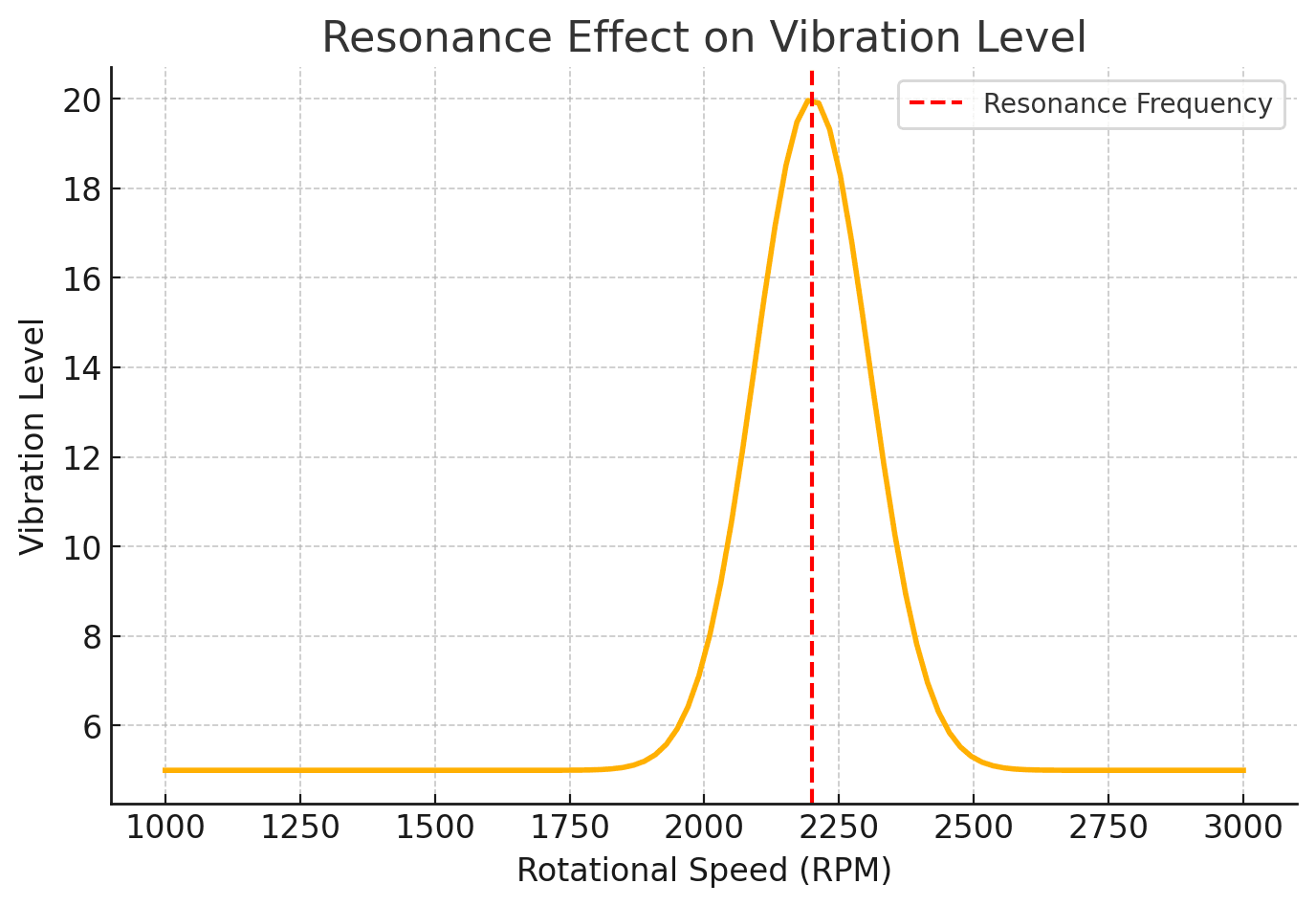
Fig. 1. Resonance graph: a sharp vibration peak as the critical speed is reached (in this example ~2250 rpm).
Signs of operating in the resonance zone:
- A sharp increase in vibration at a particular rotational speed
- When the speed changes by ±100 rpm, the vibration changes 5-10 times over
- The vibration phase "jumps" from one measurement to the next
- As resonance is passed through, the phase changes by 180°
- The readings are unstable even at constant speed
Detection methods:
1. Coast-down test (run-down):
- The equipment is switched off and slows down
- Vibration is measured as the speed falls
- Vibration peaks at the resonant frequencies are visible on the graph
2. Bump test:
- The stationary equipment is struck with a modal hammer
- The system's response is analysed
- The natural frequencies are determined
Diagnosing resonance phenomena
We carry out vibration diagnostics and determine the natural frequencies of your equipment
Request diagnosticsMethods for dealing with resonance
1. Changing the working speed
Where possible, change the speed so that the working frequency is well clear of the resonant one (usually by ±15-20%).
2. Changing the stiffness of the structure
- Strengthening the frame and foundations: increasing stiffness raises the natural frequency
- Adding mass: increasing the mass lowers the natural frequency
- Changing the supports: using vibration isolators or stiffer fixings
3. Damping
- Fitting dampers (vibration absorbers)
- Using vibration-isolating mounts
4. Special balancing methods
For working near resonance, there are special balancing methods that disregard the phase (the four-run method). This is, however, a complex procedure that requires experience.
Conclusion
Resonance is a serious phenomenon that cannot be ignored. If your equipment operates close to a resonant frequency, ordinary balancing will not solve the vibration problem.
Key takeaways:
- Resonance occurs when the rotational frequency coincides with the structure's natural frequency
- Vibration can grow 10-20 times over even with a minimal imbalance
- Balancing in the resonance zone is practically impossible with standard methods
- You must either change the working speed or change the stiffness of the structure
Professional vibration diagnostics make it possible to detect resonance phenomena and propose the right solution — not balancing, but eliminating the resonance itself.
Resonance diagnostics
Instruments and services for detecting and eliminating resonance phenomena
The Balanset-1A instrument
An instrument for the coast-down test and identifying critical speeds
Buy the instrumentQuick checklist
- Watch for vibration jumping 5-10x with small speed changes
- Run a coast-down test and note vibration peaks
- Use a bump test to find natural frequencies
- Shift working speed clear of resonance by +/-15-20%
- Change structure stiffness, mass or supports
- Add dampers or vibration isolators