Last reviewed 30 May 2026
Balancing Agricultural Machinery: A Complete Guide to Improving Reliability on the Farm
Farming runs to the rhythm of the seasons. Every hour counts when you are drilling or harvesting. A breakdown at this time is not just idle equipment — it means direct losses through spoiled crops, lower-quality produce and missed deadlines.
The reliability of farm machinery comes to the fore. Timely vibration diagnostics and the balancing of rotating assemblies are among the key factors in keeping machines running without failure precisely when they are needed most.
Experience shows: unbalanced rotors can cut a machine's output by as much as 30% and accelerate wear on components. Constant vibration is destructive to the bearings and the frame of a combine or mulcher, quietly shortening the equipment's service life.
What imbalance is in farm machinery: in plain language
The easiest way to picture imbalance is through everyday examples. Remember how a washing machine "jumps" on the spin cycle when the laundry bunches up to one side? Or how a car's steering wheel shudders at speed if a wheel has not been balanced after a tyre change? In both cases the culprit is an uneven distribution of mass about the axis of rotation.
Exactly the same thing happens in the rotors of farm machines: the metal is heavier in one place and lighter in another, and run-out develops as it spins.
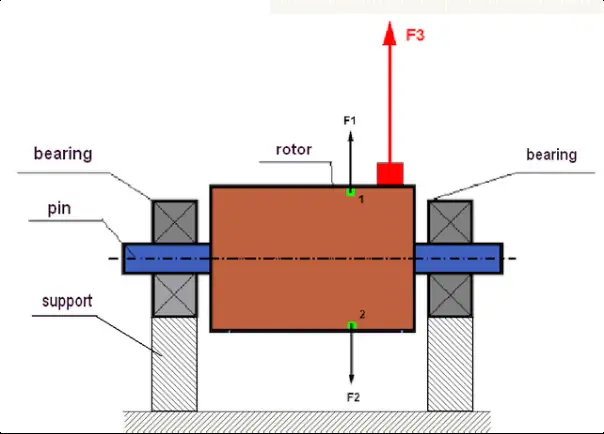
Fig. 1. How vibration arises: imbalance creates an unbalanced centrifugal force that is transmitted to the bearings and the frame
Static and dynamic imbalance
Static imbalance is when the rotor's centre of mass does not coincide with its geometric axis. If you remove such a rotor and let it turn freely, it will always come to rest with the heavy spot at the bottom. The fix is to add a weight on the opposite side (or remove material from the heavy side) until the rotor will sit still in any position.
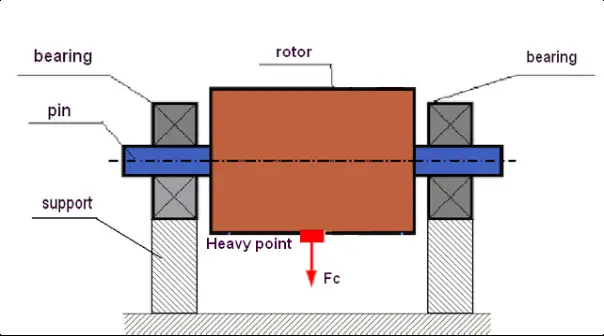
Fig. 2. Static imbalance: the heavy spot always rotates to the bottom
Dynamic imbalance is the more insidious problem. It arises when the heavy spots are at different ends of the rotor. At rest they can partly cancel each other out (the rotor looks true on its knife-edges), but at operating speed they generate forces that rock the rotor in different planes. The result is severe vibration, even though everything looked fine "statically".
Imbalance like this can no longer be removed with a single weight — you have to balance in two planes at once (at each end of the shaft).
The symptoms of imbalance in farm machinery
The signs that should make you suspect a problem:
- Vibration, droning and noise: the combine or mower "hammers" as it travels, you feel a shudder in the frame and steering wheel, and an unusual drone appears. It is especially noticeable at higher rotor speeds
- Bearings running hot and wearing out: the bearings heat up more than usual and need frequent replacement (once a season or more often)
- Loose fasteners and cracks: vibration gradually works nuts and bolts loose. Fine cracks appear on the frame, along with traces of metal dust around the joints
- Uneven wear of the knives or bars: one side of the drum or rotor wears more heavily than the other
If you have noticed even one of these symptoms, it is worth carrying out diagnostics and balancing the troublesome assembly. Ignoring vibration is dangerous for the machine.
Where to look for imbalance: the critical assemblies of combines and mowers
Almost any heavy rotating assembly spun up to high speed is prone to imbalance. Let us look at the main assemblies in combines and trailed equipment that need attention:
The combine's threshing drum
In conventional combines the threshing drum is the main "impact" rotor, spinning up to 500–1,000 rpm. It weighs a hundredweight or more and is fitted with rasp bars. The factory balances the drum, but after a few seasons that balance is often disturbed: the bars wear unevenly, soil cakes on somewhere, a couple of parts get swapped during a repair — and run-out appears.
An unbalanced drum causes the whole body of the combine to vibrate and accelerates wear on the bearings, sieves, straw-walker flaps and drive belts. The rule is simple: after any work on the drum (replacing bars, the shaft or bushings) it must be dynamically rebalanced.
The separation rotor or beater
Besides the main drum, a combine has other rotating parts in the threshing and separation unit. In the conventional layout a beater sits behind the drum (throwing the crop onto the straw walkers) — it too spins fast and can vibrate. In rotary combines a long axial rotor (with its axis of rotation along the line of travel) is used instead of a drum, doing everything from threshing to separation.
Such a rotor — a massive helical drum — is extremely demanding to balance. Any of these assemblies, if unbalanced, reduces threshing quality and can knock out expensive sub-assemblies (the sieve box, the straw walkers, the bearings).
Balancing agricultural equipment
We balance the rotors of combines, choppers, mowers and other farm machinery
Check call-out availabilityBalancing methods: from simple to effective
So how do you remove imbalance? In broad terms the idea is clear: you add or remove weight in the right place to true up the rotor. But finding that place and that amount of weight is not so simple in practice — especially if the imbalance is dynamic. Let us look at the main methods.
"By eye" (static balancing on knife-edges)
Many rural handymen still try to balance drums exactly this way. They remove the rotor, rest it on two horizontal knife-edges or suspend it on its axis and let it turn. When the heavy side comes to rest at the bottom, they fix a weight to the opposite side (or drill holes in the heavy side to lighten it).
They repeat this until the rotor stops creeping round on its own — a sign that the centre of mass has roughly coincided with the axis. The method is simple and needs no instruments, which is why it is popular.
The result, however, is often misleading. Balancing like this removes only static imbalance and is completely powerless against dynamic imbalance. For narrow parts (pulleys, wheel discs) it is enough, but for long shafts it is not.
Machine balancing (dynamic, in the workshop)
A more reliable approach is to remove the rotor and take it to a workshop that has a stationary balancing machine. On the machine the rotor is spun up, and vibration and phase sensors pick up the imbalance. From the readings, the technician works out where and how much weight to add (or where to grind off metal).
Balancing is usually carried out in two planes — that is, it removes both static and dynamic imbalance. This is exactly how factories achieve the perfect balance of new parts.
Field balancing (on site, without dismantling)
The most practical method for farm machinery is on-site (field) balancing with a portable analyser such as the Balanset-1A. The rotor stays in the machine: vibration sensors are mounted on the bearing housings, the assembly is run at its working speed, and the instrument calculates exactly where and how much correction weight to add — with no need to remove the rotor or take it to a workshop.
The advantages of field balancing:
- Minimal dismantling — there is no need to remove the rotor, you just have to provide access to it
- Time saved — an assembly can be balanced in 1–2 hours right there in the barn or at the edge of the field
- Accuracy almost as good as the factory's — vibration is reduced to single figures in mm/s
- Real operating conditions are taken into account — vibration is removed in the very conditions the machine works in
Balancing — saving money and keeping machines reliable
Many farmers are not entirely convinced that balancing pays off. Let us work out what regular balancing delivers in financial and practical terms:
Fewer repairs and parts replacements
The most immediate effect: by removing imbalance you greatly extend the life of bearings, shafts, belts and fasteners.
A worked example: a combine drum bearing might cost, say, €250–€450, plus the labour to fit it. If it fails twice a season because of vibration, that is €900 a year. Balance the drum and it will run 3–5 seasons without a bearing change.
The same goes for belts — vibration causes slipping and overheating, and belts crack. A cracked frame means welding, reinforcing, and possibly replacing the whole assembly. Balancing removes the root of the problem — the vibration — and the assemblies stop destroying themselves.
No downtime — the whole crop saved
A combine breakdown in the busy season is a serious problem. Every day lost increases the risk of crop losses and affects quality (over-ripening, shedding). An unbalanced rotor is a time bomb that can "go off" at the very peak.
Say a bearing fails from vibration — the combine stops. Between finding the spare part and fitting it, you lose several days, perhaps a week. The grain has shed, the moisture has gone, plus the cost of an emergency repair.
By balancing the assemblies in advance, as a planned task, you remove this risk. The machine runs reliably precisely when it is needed most.
Conclusion: balance is the foundation of reliable farm machinery
Rotor vibration is a problem that can turn into major trouble. We have seen how a slight imbalance leads to a chain of consequences: from broken bearings and cracks in the frame to reduced output and breakdowns.
Fortunately, today the solution is within reach of every farm. Regular balancing of the key assemblies — threshing drums, rotors, straw choppers, mulchers — lets you avoid most breakdowns and keep machinery in service all season.
What is effective is dynamic balancing using instruments — the old "by eye" methods do not deliver the accuracy required. Modern portable vibration analysers let you balance assemblies right on site, without lengthy dismantling.
The bottom line: balancing the rotors of farm machinery is not a cost but a saving and a safeguard. The time and money you put in come back many times over: you do not lose weeks to repairs in the thick of harvest, you do not buy mountains of spare parts, and you bring the crop in on time and in full. The machinery lasts longer, and working on it is more comfortable.
Balancing agricultural machinery
Instruments and services for balancing combines, mulchers and mowers
The Balanset-1A instrument
A portable instrument for balancing in the field and in the workshop
Buy the instrumentQuick checklist
- Watch for vibration, hot bearings, loosening bolts, uneven wear
- Rebalance the drum after any work on it
- Prefer dynamic two-plane balancing over by-eye
- Use field balancing with a portable analyser on site
- Mount vibration sensors on the bearing housings
- Run the assembly at working speed during balancing