Last reviewed 30 May 2026
Electric Motor Armature Balancing: Why It Is Essential After Rewinding and Repair
Electric motor rotors and armatures are among the most common objects for balancing. After rewinding the windings, an overhaul, or even a simple strip-down and reassembly of the motor, rotor balancing becomes a mandatory procedure.
Why it matters: Even a small imbalance at high speed (1500–3000 rpm) generates significant vibration forces. Bearing life can be cut from several years to just a few months.
Why balance is lost during motor repair
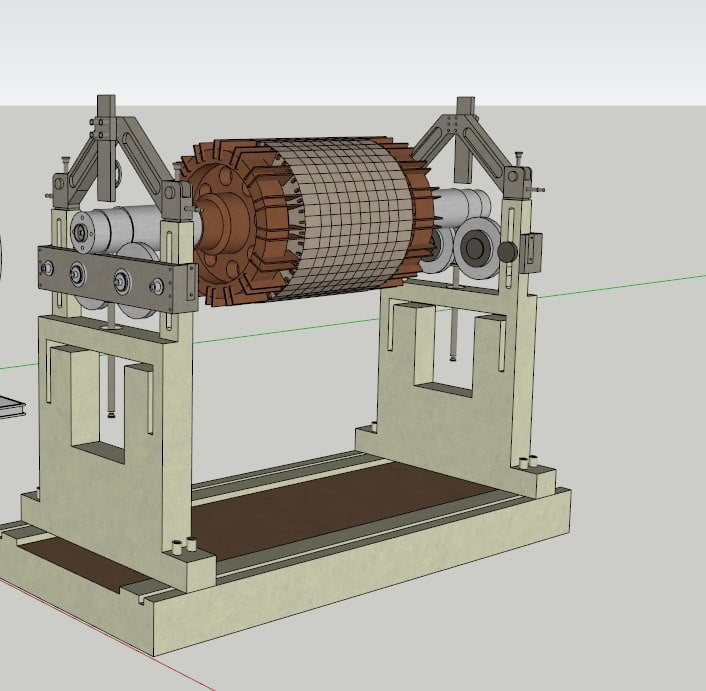
Photo. An electric motor rotor mounted on a balancing machine: support bearings, vibration measurement sensors, and the imbalance analysis system
During rewinding:
Rewinding is the most common cause of lost balance:
- Uneven placement of conductors: the winding is wound with a slight asymmetry
- Varying winding density: in some slots the conductor is packed more tightly, in others more loosely
- Varying number of turns: an error during winding
- Wedges and insulation: uneven distribution of insulating materials and wedges in the slots
Even a small difference in winding mass on opposite sides of the rotor (5–10 grams) at a radius of 100–150 mm creates a noticeable imbalance.
During disassembly and reassembly:
- Tolerances when fitting the rotor onto the shaft
- A slight misalignment during installation
- Changes to balancing weights (where fitted at the factory)
During cooling-fan repair:
Many electric motors have a cooling fan on the shaft. Replacing or repairing the fan blades upsets the overall balance of the system.
The consequences of imbalance for electric motors
- Accelerated bearing wear: this is the first and most common consequence. Motor bearings are an expensive component, and replacing them frequently is uneconomical
- Vibration transmitted to the driven machine: if the motor is coupled to a pump or fan, vibration spreads through the whole unit
- Winding overheating: vibration can cause micro-movements of the winding in the slots, leading to chafing of the insulation
- Noise: an unbalanced motor runs louder
- Reduced efficiency: part of the energy goes into vibration rather than useful work
Balancing electric motor armatures and rotors
We balance armatures after rewinding on precision machines
Request the serviceThe specifics of balancing electric motor armatures
Mechanical and magnetic imbalance
Electric motors can suffer from two kinds of imbalance:
Mechanical imbalance:
- Uneven distribution of rotor mass
- Removed by ordinary balancing (adding/removing weights)
Magnetic imbalance:
- Asymmetry of the magnetic field due to uneven windings
- Creates vibration that cannot be removed by mechanical balancing
- Requires the winding to be redone
Balancing as an assembly
The armature is often balanced as an assembly:
- Armature + commutator (for DC motors)
- Rotor + cooling fan + pulley
- The entire rotating system
Required balance quality grade
Depending on the application:
- G6.3 — general-purpose electric motors (the standard)
- G2.5 — special-purpose electric motors, machine-tool drives
- G1.0 — high-speed motors, precision drives
Methods of balancing electric motors
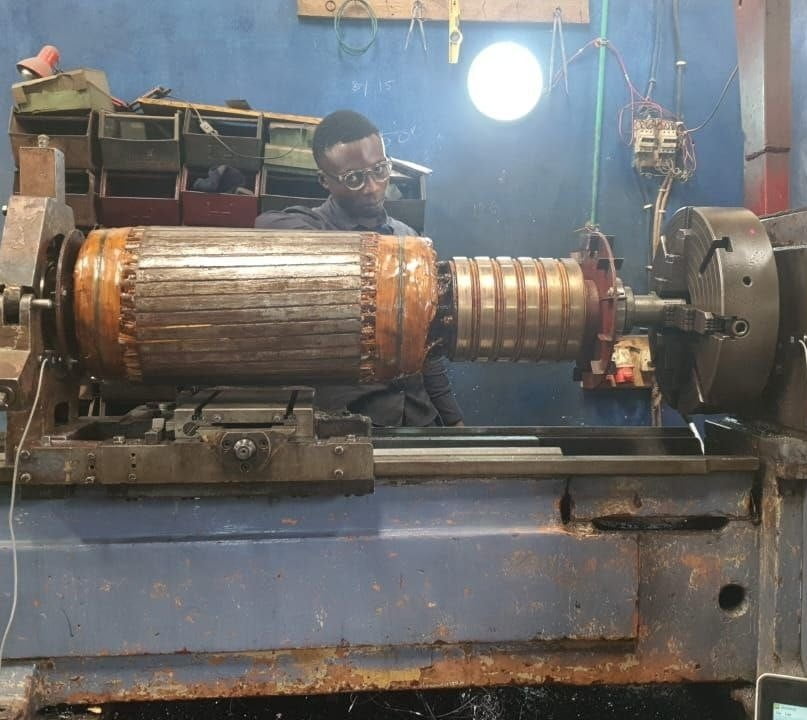
Photo 2. Balancing the rotor of a large electric motor on a specialised balancing machine in the workshop
Balancing the armature on a machine
The most widespread method for repair shops:
- The armature is removed from the motor
- It is mounted on a balancing machine
- Balancing is carried out in 2 planes (dynamic)
- Correction weights are usually fitted to the end faces or into special grooves
Advantages:
- High accuracy
- Convenience (the armature is already removed for repair)
- Ability to achieve grade G2.5 and better
Balancing the motor in its assembled state
For large motors installed on site:
- Balancing is carried out without dismantling
- Portable equipment is used
- It accounts for the influence of the coupling and the alignment with the driven machine
The catch: when balancing a motor in its assembly, it must be uncoupled from the driven machine (pump, fan) to rule out their influence.
Practical recommendations
When balancing is mandatory:
- After rewinding: always, without exception
- After bearing replacement: recommended (tolerances can build up during assembly)
- After cooling-fan repair: if the blades were changed
- When vibration appears: if the motor has started to vibrate
How to distinguish mechanical from magnetic imbalance:
Mechanical imbalance:
- Vibration at the rotational frequency (1× = 50 Hz for 3000 rpm on a 50 Hz supply)
- Removed by balancing
Magnetic imbalance:
- Vibration at twice the mains frequency (2× = 100 Hz for a 50 Hz supply)
- Not removed by mechanical balancing
- Requires inspection of the windings (broken rotor bar, winding asymmetry)
Fitting balancing weights:
Typical fitting locations:
- The rotor end faces (plates are welded or bolted on)
- Balancing grooves on the end faces (where provided)
- The cooling-fan blades (if fitted to the shaft)
Quality check:
After balancing, verify that:
- Vibration has fallen into zone A or B (usually below 2.8 mm/s for mid-power motors)
- Residual imbalance is within grade G6.3 or G2.5
- The bearings do not overheat in service
- There are no unusual noises
Conclusion
Balancing an electric motor armature after rewinding or repair is not optional but mandatory. It ensures:
- Bearing life extended by a factor of 3–5
- Vibration reduced to within standard limits
- Prevention of premature failure
- A quality repair and a satisfied customer
The cost of balancing an armature (typically €200–600) is negligible compared with the cost of a repeat repair or a motor being returned under warranty.
Electric motor balancing
Instruments for armature balancing and specialist services
Balanset-1A instrument
A balancing instrument for electric motor rotors and armatures
Buy the instrumentQuick checklist
- Check the vibration spectrum before balancing
- Distinguish 1x mechanical from 2x mains magnetic imbalance
- Balance the armature in two planes on a machine
- Fit correction weights to end faces or grooves
- Confirm vibration falls into zone A or B
- Verify residual imbalance meets G6.3 or G2.5