Last reviewed 30 May 2026
In-Situ Balancing vs. Workshop Balancing: Which to Choose for Your Equipment?
There are two basic approaches to carrying out balancing work, each with its own advantages and limitations. The choice between balancing on a dedicated machine and balancing directly where the equipment is installed is not merely a question of convenience but a strategic decision that affects cost, downtime and the final result.
In this article we look at both methods in detail, analyse their strengths and weaknesses, and help you make an informed decision for your particular situation.
Method 1: Balancing on a balancing machine (in the workshop)
How it works
The component (rotor, shaft or impeller) is removed from the main equipment and taken to a dedicated balancing centre. There it is mounted on a high-precision balancing machine, which spins the rotor up to the required speed and performs all the necessary measurements and calculations.
Advantages
- High balancing accuracy for an individual component: balancing machines provide precise measurement and make it possible to bring the residual imbalance below the tolerances set by the standards.
- Controlled conditions: all operations are carried out in the workshop at an optimal temperature, free from external vibration and interference.
- The option of accompanying work: turning, welding and the replacement of worn parts can be done at the same time.
- A standardised process: especially useful when balancing series-produced parts.
Disadvantages
- Long equipment downtime: it requires complete dismantling, transport and subsequent reassembly of the component. This can take days or even weeks.
- High total cost: the price includes not only the balancing but also the dismantling, transport and reassembly.
- It does not account for the system's influence: a rotor balanced perfectly on the machine may vibrate once installed in the unit, owing to the influence of couplings, bearings, the foundation or alignment.
- Size limitations: not every machine is suitable for large or heavy rotors.
Method 2: In-situ balancing (where the equipment is installed)
How it works
Balancing is carried out directly on the customer's equipment, in its own bearings, without removing the rotor. A specialist with a portable vibration measurement system and a laser tachometer balances the unit at its working speed, right where it operates.
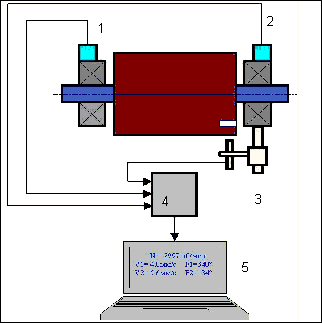
Fig. 1. Sensor installation for in-situ balancing: 1, 2 - vibration sensors on the bearings, 3 - laser speed sensor, 4 - measurement unit, 5 - laptop with the software
Advantages
- Minimal downtime: the work often takes just a few hours. No dismantling of the unit is required.
- Substantial cost savings: there is no expenditure on dismantling, transport and reassembly.
- Balancing the system as a whole: the main advantage — it takes account of real conditions: the stiffness of the foundation, the state of the bearings, the couplings and shaft alignment.
- Versatility: suitable for large equipment and equipment that is difficult to dismantle.
- Work on site: the specialist comes to you, with no need to transport the rotor anywhere.
Disadvantages
- It requires access to the rotor: there must be a way to fit the correction weights.
- Starts and stops are required: the process needs 3-4 start-up cycles of the equipment for measurement.
- The influence of external factors: vibration from neighbouring equipment or unstable speed can complicate the work.
A detailed comparison table
| Criterion | On a balancing machine | In situ (on site) |
|---|---|---|
| Accuracy | High for an individual component | High for the system as a whole under real conditions |
| Downtime | Days/weeks (dismantling, logistics, reassembly) | Hours (usually 2-4 hours) |
| Total cost | High (includes dismantling, reassembly, transport) | Medium (depends on the cost of the specialist's visit) |
| Dismantling | Mandatory | Not required |
| Accounts for system factors | No (an individual part is balanced) | Yes (foundation, bearings, couplings, alignment) |
| Where it applies | New parts, after repair, series production | Equipment in service, large components |
We will help you choose the optimal balancing method
Advice on choosing the balancing method for your particular equipment.
Request a consultationHow to choose the optimal method: a decision checklist
Choose WORKSHOP balancing if:
- You are balancing a new part before installation.
- The rotor is fresh from an overhaul or manufacture.
- The part is small and easy to remove.
- You require very high accuracy (grade G1.0 or better).
- Accompanying mechanical work is needed (turning, weld build-up).
- Downtime is not critical.
Choose IN-SITU balancing (on site) if:
- The equipment is large (big fans, induced-draught fans).
- Dismantling is difficult, expensive or impossible.
- Downtime is critical (production cannot wait).
- The rotor operates as part of a complex system (couplings, drive).
- Real installation conditions need to be taken into account.
- You need to eliminate vibration in the whole unit, not just the rotor.
Practical application examples
Example 1: a boiler induced-draught fan
The task: elevated vibration in a 200 kW induced-draught fan.
The solution: in-situ balancing of the impeller.
The rationale: removing the impeller would have meant shutting the boiler down for several days. The in-situ balancing was completed in 3 hours during a planned shutdown.
Example 2: an electric-motor armature after rewinding
The task: balancing a 30 kW armature after the winding was rewound.
The solution: workshop balancing in the repair shop.
The rationale: the armature had already been removed for repair. Workshop balancing provides high accuracy and is convenient, since the part is already in the workshop.
Conclusion
Both methods — workshop balancing and in-situ balancing alike — eliminate imbalance effectively when carried out correctly. The choice depends on the specific situation:
- If the rotor is easy to remove and requires high accuracy — the machine.
- If dismantling is difficult, time is critical or system factors need to be taken into account — in-situ balancing.
Many specialist centres offer both kinds of service: they have their own balancing machines for various rotor sizes as well as mobile teams for visits to customers.
Rotor balancing
Instruments for in-situ balancing and workshop balancing services.
Quick checklist
- Assess how easily the rotor can be removed
- Decide if downtime is critical for production
- Check whether very high accuracy (G1.0+) is needed
- Consider if accompanying machining is required
- Account for couplings, bearings and foundation
- Consider a rough machine balance then on-site fine-tune