Last reviewed 30 May 2026
Balancing Crushers and Mills: Working in Extreme Conditions
The specifics: Crushing equipment works in the most demanding conditions — shock loads, abrasive wear and material build-up. Balancing here calls for a special approach.
Introduction
Crushers and mills are among the most demanding pieces of equipment to operate. Their rotors work under constant shock loads, suffer extreme abrasive wear and experience build-up of the material being processed.
The key problem: imbalance here is not static — it constantly changes as the working elements (hammers, beaters, knives) wear or fail.
Types of crushing equipment

Photo 1. Balancing a crusher at a Nestlé plant: preparing the equipment for vibration diagnostics and balancing in production conditions
1. Hammer crushers
Design: a rotor with hinge-mounted hammers that swing freely on their axles.
Imbalance problems:
- Uneven hammer wear — one can wear more than the others
- Hammer failure — a sudden loss of mass creates a severe imbalance
- Material build-up — wet or sticky product adheres unevenly
2. Impact crushers and mills
Design: a rotor with rigidly fixed beaters or knives.
Imbalance problems:
- One-sided wear — when processing abrasive material
- Chips and cracks in the working elements
- Metal strikes — these can bend or break a beater
Specific problems of crushing equipment
Problem 1: Extreme and uneven wear
Cause: abrasive material (ore, gravel, coal) quickly grinds down the working elements. Wear occurs unevenly because of the non-uniformity of the material and the feeding regime.
Consequences: imbalance grows quickly. If a hammer weighed 5 kg and, after a month's work, weighs 4.5 kg, that is already a serious imbalance for the rotor.
The specifics of balancing crushers
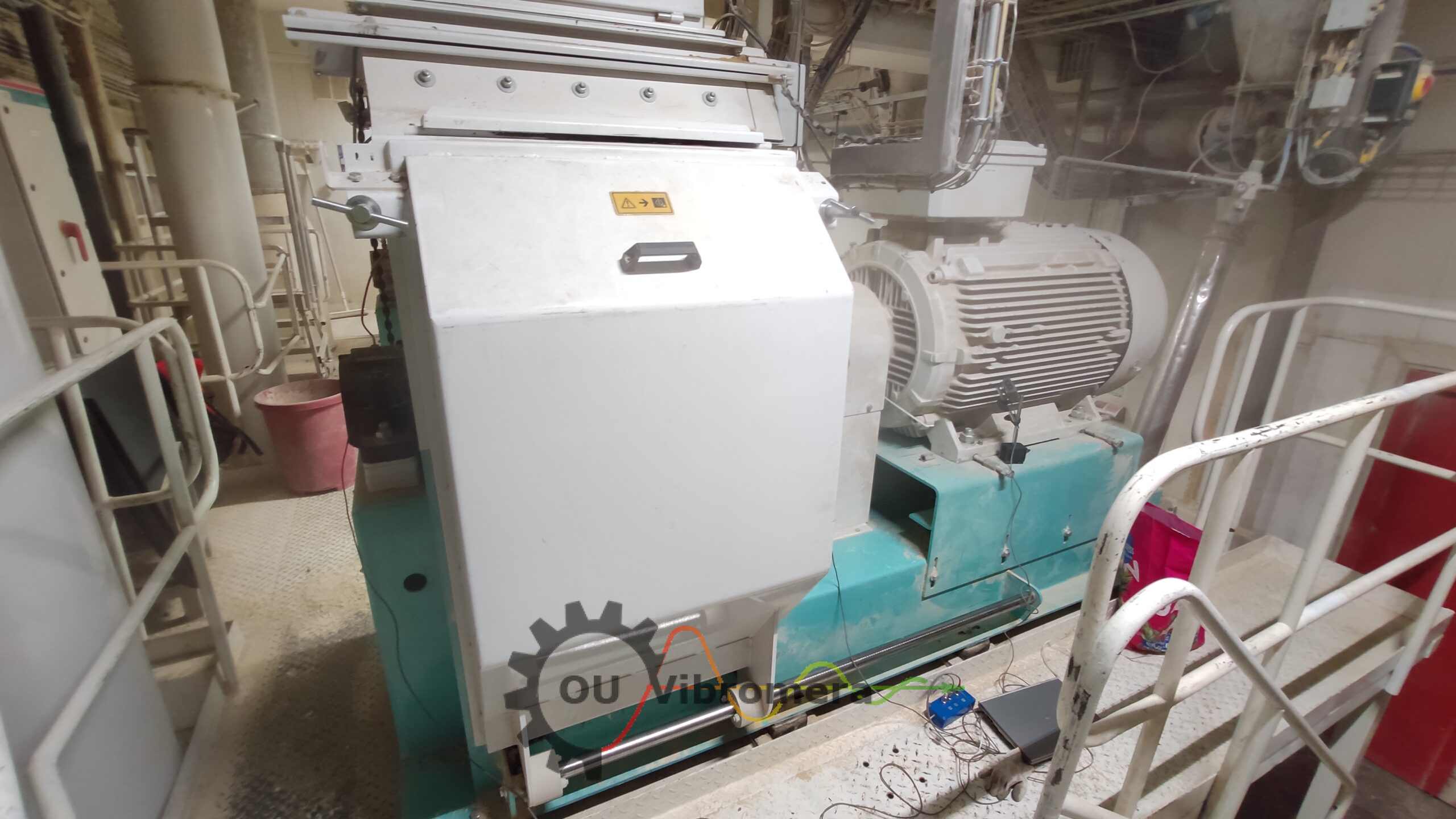
Photo 2. Balancing a crusher: vibration sensors fixed to the bearing supports while measurements are taken to determine the imbalance
Preparation: critically important!
- Cleaning the rotor: remove EVERYTHING that has built up. Use scrapers, pressurised water and compressed air
- Inspecting the hammers/beaters: check the integrity of EVERY element. Cracks or chips mean replacement
- Checking the fixings: tighten all bolts. Crushers work with impacts, so fixings work loose
- The foundation: check the anchor bolts. Shock loads can loosen them
Practical recommendations
Checklist before balancing a crusher
- Cleaning: rotor cleaned of all built-up material (100%)
- Inspection: all hammers/beaters intact, no cracks
- Completeness: the number of hammers matches the design
- Symmetry: if the hammers are worn, replace the whole set with new ones
- Rotor fixings: bolts tightened, keys in place
- Bearings: no play, no overheating, lubrication in order
- Foundation: anchor bolts tightened, no cracks
Real-world case: a crusher at a precast concrete plant
The starting situation
Object: a hammer crusher for crushing gravel
Problem: strong vibration (12 mm/s), noise, cracks in the foundation
Cause: 3 of 24 hammers broken, the rest worn unevenly
Work carried out
- Stop the crusher, remove the guards
- Inspect the rotor — 3 broken hammers found
- Replace the ENTIRE set of hammers (24 pieces) with new ones
- Balance the rotor in its own bearings with the Balanset-1A
- Reinforce the foundation (strengthen with concrete)
The result
- Vibration reduced from 12 to 2.8 mm/s (within standard limits)
- Noise reduced by ~15 dB
- Output increased by 8%
The economics
Costs:
- Set of hammers (24 pieces): €7,200
- Balancing: €1,400
- Foundation reinforcement: €1,800
- TOTAL: €10,400
Annual benefit:
- Downtime avoided: 15 days × €3,200 = €48,000
- Bearing life tripled: a saving of €4,800/year
- 8% output increase: +€14,000/year in additional profit
- Total benefit: €66,800/year
ROI: €66,800 / €10,400 = 6.4× (payback in 2 months)
Conclusion
Balancing crushing equipment is work in extreme conditions that demands a special approach. The key principles of success are:
- Thorough preparation: cleaning, inspection and replacing worn elements as a set
- Reliable fixings: correction weights must withstand shock loads
- Regularity: balance according to actual wear, not just on a schedule
- A holistic approach: vibration + foundation + bearings + drive
With the right approach, balancing a crusher pays for itself in 2–3 months by avoiding downtime and extending the life of the equipment.
Balancing crushing equipment
Instruments for balancing and specialist services
Quick checklist
- Clean all built-up material from the rotor
- Inspect every hammer or beater for cracks
- Replace worn hammers as a full set
- Tighten rotor bolts and check keys
- Check bearings for play and overheating
- Tighten foundation anchor bolts, inspect cracks