Last reviewed 30 May 2026
5 Causes of Industrial Fan Vibration and How to Fix Them
An ordinary working day at the plant. Suddenly a rising hum spreads across the workshop and the floor begins to vibrate gently... The production line is under threat of an unplanned shutdown. The hunt for the cause begins, and with it the risk of disrupting the production schedule.
Sound familiar? As practice shows, in 9 cases out of 10 the culprit is imbalance in the fan impeller. This is a problem that simply cannot be left to run its course.
The facts: An industrial fan running with imbalance consumes 15–25% more electrical energy and can destroy bearings up to five times faster than under normal operation. Continuous vibration quietly wears out bearings, loosens fixings and overloads the motor.
In this article we will work through the five main causes of fan vibration, learn how to diagnose them, and look at modern methods for eliminating the problem.
Cause 1: Impeller imbalance (the most common)
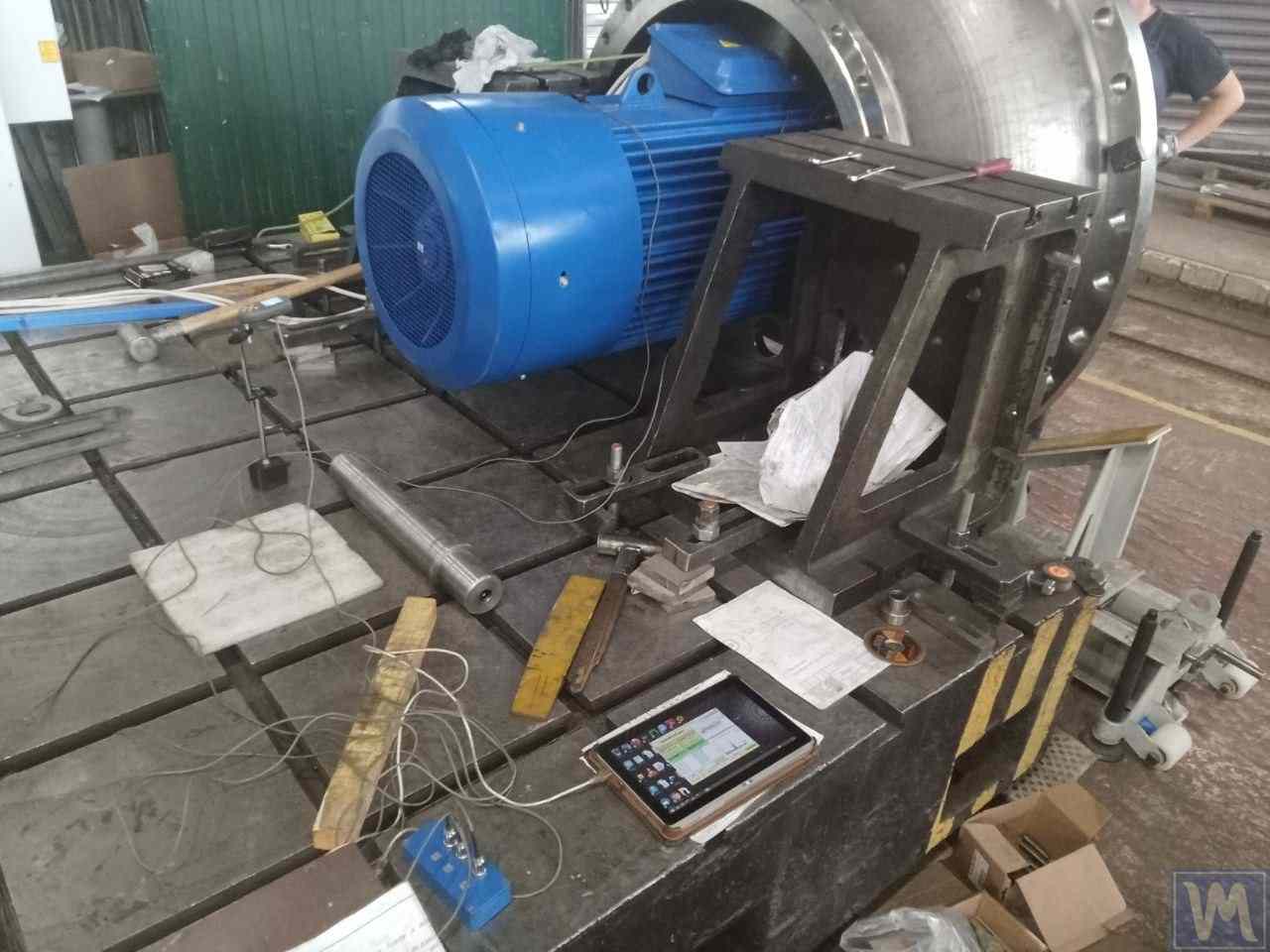
Photo 1. Balancing an industrial fan in progress: vibration sensors fitted to the bearings, a laser tachometer aimed at the shaft, and diagnostic data displayed on the tablet
Imbalance is the uneven distribution of mass around the impeller relative to its axis of rotation. Even a small shift in mass leads to runout: part of the motor's energy goes not into moving air, but into vibrating the casing.
How imbalance develops:
- Material build-up: during operation, dust, dirt and process product accumulate on the blades, shifting the centre of gravity
- Uneven wear or corrosion: blades wear at different rates, especially in abrasive environments
- Repair work: replacing or weld-repairing individual blades without re-balancing afterwards destroys the factory balance
- Loss of balancing weights: previously fitted weights can come off due to vibration or corrosion
Symptoms of imbalance:
- Strong casing vibration, particularly noticeable at higher speeds
- Low-frequency hum transmitted into the foundation
- Overheating bearings (above 60–70°C)
- Frequent bearing replacement
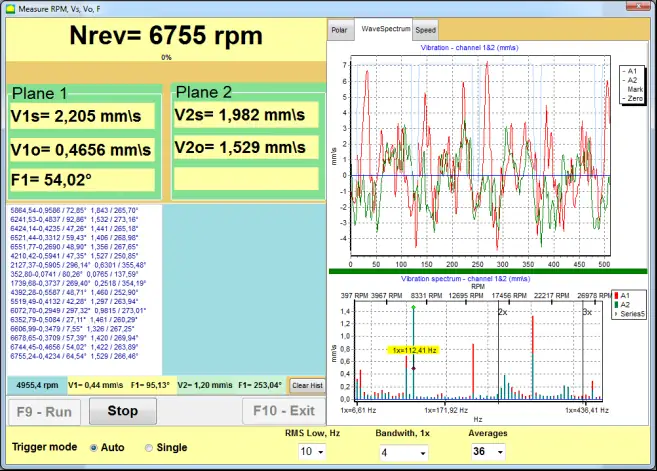
Fig. 1. Diagnosing imbalance: if the overall vibration (V1s) is roughly equal to the vibration at the rotational frequency (V1o), the main cause is impeller imbalance
Solution:
Dynamic balancing of the impeller. Modern portable vibration analysers (such as the Balanset-1A) make it possible to balance the impeller right where it operates, without dismantling the fan.
Photo 2. Vibration analysis with a trial weight fitted, speed ~2960 rpm
The engineer fits vibration sensors to the bearing supports and an optical speed sensor on the shaft. After a few measurements, the instrument calculates the exact position and mass of the correction weight. The whole process takes 1–2 hours.
Cause 2: Worn or damaged bearings
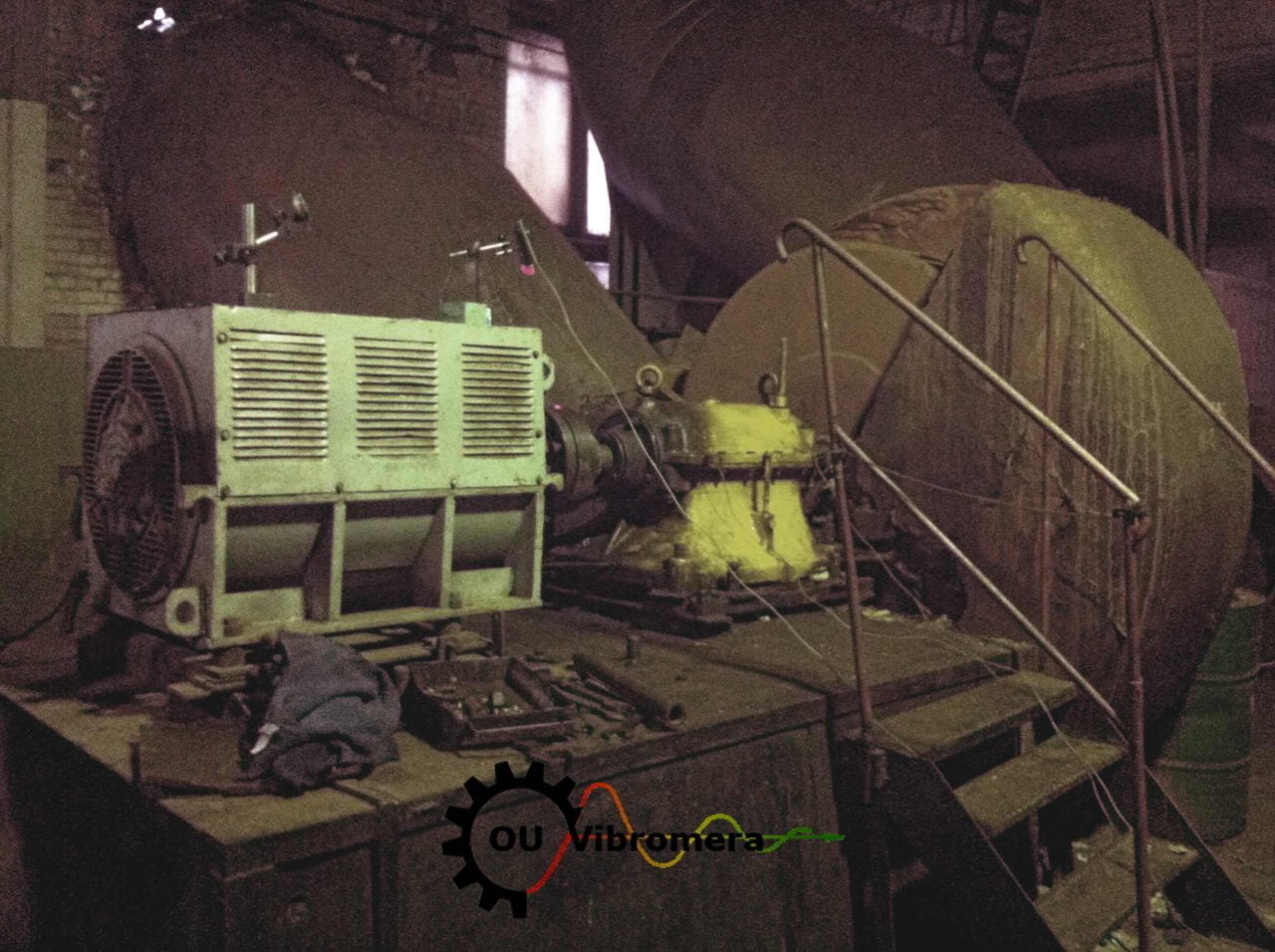
Photo 3. Balancing the impeller of an extraction fan: the work is carried out directly on site without dismantling the equipment
Bearings are a critically important component of any fan. According to the statistics, up to 80% of bearing failures are caused by balancing or alignment problems. That said, worn bearings can themselves be a source of vibration.
Symptoms of defective bearings:
- High-frequency noise (rustling, droning) unrelated to the rotational frequency
- Elevated bearing housing temperature
- Vibration does not reduce after balancing
- In the vibration spectrum, peaks appear at non-synchronous frequencies (BPFO, BPFI, BSF)
How to tell it apart from imbalance:
With imbalance, vibration appears mainly at the rotational (1×) frequency. With bearing defects, vibration occurs at characteristic "bearing" frequencies that are NOT multiples of the shaft speed.
Solution:
Replace the bearings. After replacement it is advisable to carry out balancing, because fitting new bearings can change the balance of the system.
Fan vibration diagnostics
We will pinpoint the exact cause of your fan's vibration: imbalance, bearings, misalignment or resonance
Request diagnosticsCause 3: Shaft misalignment
Misalignment occurs when the axes of rotation of the fan shaft and the motor shaft do not coincide. This places additional load on the bearings and coupling and causes vibration.
Types of misalignment:
- Parallel: the axes are parallel but offset
- Angular: the axes intersect at an angle
- Combined: a mixture of both types (the most common case)
Symptoms of misalignment:
- High vibration at 2× the rotational frequency (the second harmonic)
- Elevated axial vibration (along the shaft)
- Overheating of the coupling
- Rapid wear of the coupling and bearings
Solution:
Laser shaft alignment. Modern laser alignment systems allow shafts to be aligned to within hundredths of a millimetre. After alignment it is advisable to take a check vibration measurement.
Read more: Shaft alignment and why balancing won't help without it
Cause 4: Mechanical looseness or foundation damage
Mechanical looseness is a loss of stiffness in the structural joints. Causes include loose fixing bolts, cracks in the foundation, and increased clearances in bearing seats.
Symptoms of looseness:
- Multiple harmonics in the vibration spectrum (1×, 2×, 3×, 4×...)
- The spectrum looks like a "forest" of peaks
- Vibration is unstable from one start-up to the next
- Visible rocking or play
Solution:
- Carefully inspect all bolted joints
- Tighten the foundation anchor bolts
- Inspect for and repair cracks in the frame
- Check the bearing seats
Once looseness is eliminated, it often turns out that this — rather than imbalance — was the real cause of the vibration.
Cause 5: Structural resonance
Resonance occurs when the fan's operating speed coincides with (or is close to) one of the natural frequencies of the structure. When that happens, even minimal imbalance produces extremely high vibration.
Symptoms of resonance:
- Vibration rises sharply at a particular rotational speed
- Changing the speed by ±100 rpm can change the vibration by a factor of 5–10
- The vibration phase shifts by 180° as it passes through resonance
- Readings are unstable even at constant speed
Solution:
Balancing within the resonance zone is practically impossible by standard methods. You need to:
- Change the fan's operating speed (where possible)
- Change the stiffness of the structure (reinforce the frame, change the supports)
- Use special balancing methods that are independent of phase
Checklist for self-diagnosis
Before calling in a specialist, carry out a simple check:
| Symptom | Likely cause | First action |
|---|---|---|
| Steady vibration across all speeds | Impeller imbalance | Clean the impeller, arrange balancing |
| High-frequency rustling, overheating bearings | Bearing wear | Check the temperature, plan a replacement |
| Strong axial vibration | Shaft misalignment | Check the coupling alignment |
| Loose bolts, cracks | Mechanical looseness | Tighten all fixings |
| Sharp rise in vibration at a particular speed | Resonance | Change the speed or reinforce the frame |
Real-world case: precast concrete plant
The problem
Equipment: Boiler-house flue-gas fan
Symptoms: Elevated vibration, bearing replacement every four months, increased energy consumption
Work carried out
Solution: Dynamic balancing of the flue-gas fan impeller in situ (without dismantling)
Time on the job: 3 hours
Results
- Annual electricity saving: €8,050
- Bearing life extended: from 4 months to 2 years
- Vibration reduced: from 8 mm/s to 1.2 mm/s
- Payback on the work: 1.5 months
This example clearly shows that balancing a fan is not a cost, but a highly profitable investment in the reliability of your equipment.
Conclusion
Industrial fan vibration can have a number of causes. The most common is impeller imbalance (up to 70% of cases), but bearing wear, shaft misalignment, mechanical looseness and resonance cannot be ruled out.
The right approach is to start with diagnostics. Modern vibration analysers make it possible to pinpoint the cause of vibration from the signal spectrum. Once the diagnosis is established, the appropriate solution is applied: balancing, bearing replacement, alignment or structural reinforcement.
Eliminating vibration promptly extends the life of the equipment, reduces energy consumption and prevents costly emergency production shutdowns.
Fan balancing
Instruments for doing it yourself and on-site balancing services
Quick checklist
- Diagnose the cause before any balancing
- Clean deposits off the impeller
- Check bearing condition and temperature
- Tighten fixing and foundation anchor bolts
- Inspect coupling alignment and axial vibration
- Watch for vibration spikes at specific speeds