Last reviewed 30 May 2026
Balancing Centrifuges and Separators: Precision Work for Safety-Critical Machinery
SAFETY-CRITICAL: the failure of an unbalanced centrifuge drum at 10,000–15,000 rpm can have catastrophic consequences. The centrifugal force at such speeds is enormous!
Introduction: why centrifuges demand a special approach
Centrifuge and separator drums rotate at extremely high speeds — from 5,000 to 15,000 rpm. At such speeds, even the smallest imbalance generates colossal centrifugal forces.
A worked example:
An imbalance of just 5 grams at a radius of 200 mm and 10,000 rpm produces a centrifugal force of:
F = m × r × ω² = 0.005 kg × 0.2 m × (1047 rad/s)² ≈ 1,100 newtons (110 kgf)
That is the equivalent of strapping a 110 kg weight to the rotor and spinning it up!
The takeaway: centrifuges are balanced to PRECISION grades (G0.4–G2.5), far tighter than ordinary equipment (G6.3).
Types of centrifuge and separator
1. Filtration centrifuges
Application: the chemical, food and pharmaceutical industries
Speed: 1,500–5,000 rpm
Balance grade: G2.5–G6.3
2. Milk separators
Application: separating milk into cream and skimmed milk
Speed: 6,000–10,000 rpm
Balance grade: G1–G2.5 (precision!)
3. Laboratory ultracentrifuges
Application: scientific research and medicine
Speed: up to 100,000 rpm!
Balance grade: G0.4 (the highest precision)
The specifics of centrifuge balancing
Requirement 1: precision accuracy
| Centrifuge type | Speed (rpm) | Grade G | Tolerance eper (μm) |
|---|---|---|---|
| Industrial | 3,000 | G2.5 | 8 μm |
| Milk separator | 8,000 | G1 | 1.2 μm |
| Laboratory | 15,000 | G0.4 | 0.25 μm |
For comparison: an ordinary fan is balanced to grade G6.3 (a tolerance of around 20 μm). A centrifuge demands balancing that is up to 80 times tighter!
Requirement 2: balancing ONLY on a machine
Why it cannot be done in its own bearings:
- The required accuracy is unattainable under field conditions
- It is impossible to create ideal measurement conditions
- Safety — high-speed test runs must be carried out inside a protective enclosure
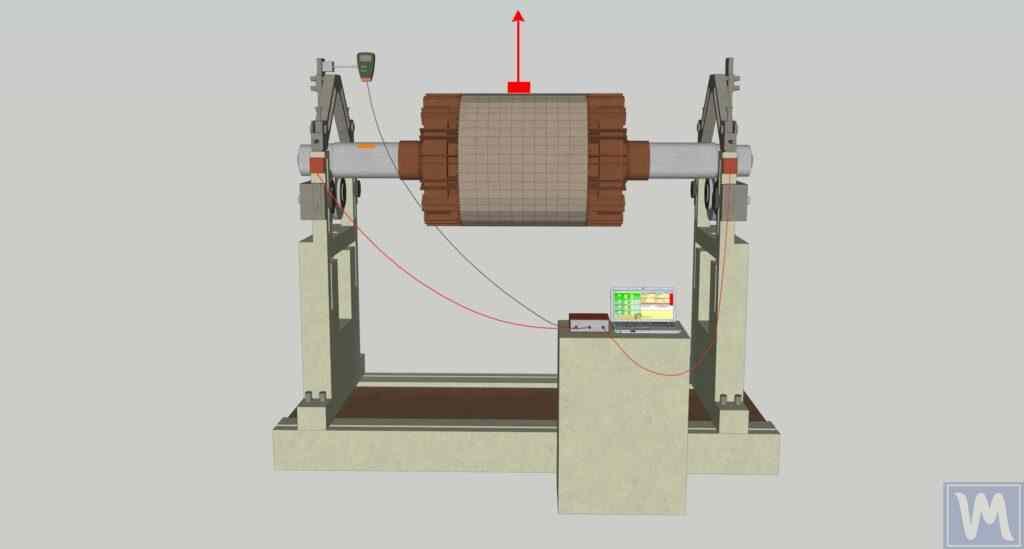
Photo 1. A centrifuge rotor mounted on a precision balancing machine to remove imbalance.
Safety when working with centrifuges
CRITICAL SAFETY MEASURES
1. Check before every start-up
- The cover is closed and secured
- There are no foreign objects in the drum
- There are no cracks in the housing or drum
2. The run-up regime
- A smooth build-up of speed (not abrupt!)
- Monitor vibration at every stage
- If any abnormal vibration appears — stop immediately
3. No overloading
- Do not exceed the rated fill capacity
- Distribute the material evenly within the drum
- Load it symmetrically
The consequences of a drum failure
Documented cases of unbalanced centrifuges failing include:
- Complete destruction of the drum, scattering fragments
- Damage to equipment within a 10–15 metre radius
- Injuries to personnel (in some cases fatal)
- Production shut down for weeks or months
The takeaway: centrifuge balancing is not a question of efficiency — it is a question of SAFETY.
Conclusion
Centrifuges and separators are machines that demand the very highest balancing accuracy. This can only be achieved on specialist machines while meeting tight tolerances (grades G0.4–G2.5).
Key rules:
- Balance ONLY on precision machines
- Check the geometry before balancing
- Follow the safety measures strictly
- Monitor vibration regularly
Cutting corners on centrifuge balancing is never acceptable — the cost of getting it wrong is far too high.
Centrifuge balancing
Precision balancing (grades G0.4–G2.5)
Quick checklist
- Balance only on a precision machine inside an enclosure
- Check geometry and housing for cracks first
- Verify cover closed and no foreign objects before start
- Build speed smoothly and monitor vibration
- Stop immediately if abnormal vibration appears
- Load material evenly and within rated capacity