Last reviewed 30 July 2026
Turbine Balancing: Mission-Critical for Power Generation
In shortTurbine rotors run at 3,000–30,000 rpm, and a CHP steam rotor weighs 20–100 tonnes. Large power-station rotors are flexible and need staged balancing at a specialist centre — 500–1,000 rpm first, then up to working speed; rigid rotors such as turbochargers balance in their own bearings.
When this applies
- After a major turbine overhaul
- After replacing or repairing blades
- When vibration crosses the A/B boundary for that machine — 4.5 mm/s for gas turbine sets (ISO 10816-4), 3.8 mm/s for steam turbines above 50 MW at 3,000 rpm (ISO 10816-2)
- On a planned basis every 2-4 years
When it doesn’t
- Large power-station rotors behave as flexible rotors: they need high-speed balancing at a specialist centre. Rigid rotors — turbochargers, small turbines, auxiliary drives — balance in their own bearings
- Cost is high and the work is multi-stage
- Large flexible power-station rotors are not a DIY task for ordinary maintenance crews
- Won't help if vibration is caused by a bearing defect, coupling misalignment or resonance — spectral diagnostics first
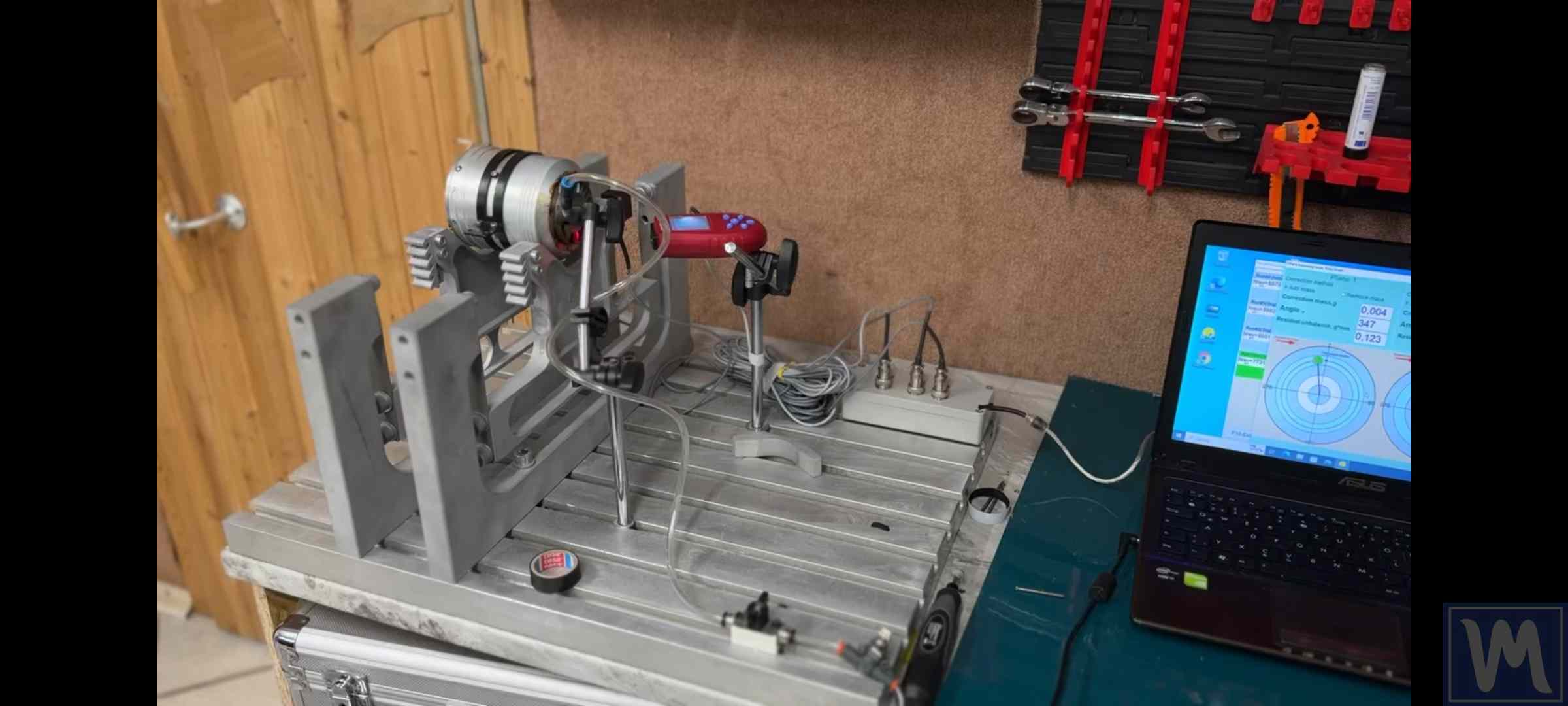
Photo. A steam turbine rotor mounted on a balancing machine in a repair workshop.
MISSION-CRITICAL EQUIPMENT: turbines are the heart of a power station. Their rotors spin at tremendous speeds (3,000–30,000 rpm), and the slightest unbalance produces destructive forces. Balancing here is critical!
Introduction: the scale of the problem
The rotors of turbines (steam, gas and hydro), turbocompressors and turbodiesels — as well as the generator rotors at power stations — operate under extreme conditions:
- Very high speeds: 3,000–30,000 rpm
- Enormous mass: a CHP turbine rotor weighs 20–100 tonnes
- Extreme temperatures: up to 500–600°C
- High pressure: up to 300 atmospheres
The consequences of unbalance:
- Vibration transmitted into the foundations of the power-station building
- Accelerated bearing wear (a single turbine bearing can cost €69,000–€172,500)
- The risk of catastrophic rotor failure
- Lost electricity generation (losses running into hundreds of thousands of euros per hour)
Types of turbine
1. Steam turbines
Application: CHP plants, nuclear power stations, large industrial sites
Output: from 5 MW to 1,200 MW
Speed: 3,000 rpm (synchronous with the 50 Hz grid)
Rotor mass: 20–100 tonnes
2. Gas turbines
Application: gas-turbine units, gas pipeline compressor stations
Speed: 10,000–15,000 rpm
Temperature: up to 1,200°C in the combustion zone
3. Hydro turbines
Application: hydroelectric power stations
Speed: 75–1,000 rpm (depending on the head)
Mass: up to 200 tonnes for large hydro plants
Balance grade: G6.3 — ISO 1940-1 lists water turbines separately from gas and steam turbines (G2.5).
Vibration limits: hydraulic machine sets have their own criteria in ISO 10816-5: the A/B boundary is 1.6 mm/s for horizontal sets on rigid foundations and for vertical sets braced against the foundation, and 2.5 mm/s where the bearing housings are braced against the machine casing — noticeably tighter than the general-purpose limits.
Watch the measurement band: at 75 rpm the rotational frequency is only 1.25 Hz, well below the default lower bound of the RMS band (10 Hz). Drop that bound in the settings before judging the vibration level of a slow-running hydro set.
4. Turbocompressors
Application: metallurgy, chemicals, oil refineries
Speed: 15,000–30,000 rpm
Balance grade: G2.5 (very tight)
Turbine balancing: the process
When balancing is required
- After a major turbine overhaul
- After replacing or repairing the blades
- When vibration crosses the A/B boundary for that machine (4.5 mm/s for gas turbine sets under ISO 10816-4; 3.8 mm/s for steam turbines above 50 MW at 3,000 rpm under ISO 10816-2)
- On a planned basis — every 2–4 years (depending on running hours)
The turbine rotor balancing process
- Dismantling: shutting the turbine down, cooling it, opening the casing and removing the rotor (this can take 3–7 days)
- Inspection: checking the geometry, examining the blades and discs
- Balancing: for a flexible power-station rotor — on a specialist machine in several stages
- Low-speed balancing: 500–1,000 rpm
- High-speed balancing: up to operating speed
- Reassembly and reinstallation
The economics of turbine balancing
Cost of the work
| Turbine type | Output | Cost of balancing |
|---|---|---|
| Turbocompressor | — | €6,900–€14,000 |
| Small steam turbine | 5–25 MW | €23,000–€69,000 |
| Medium steam turbine | 50–200 MW | €92,000–€230,000 |
| Large steam turbine | 300–1,200 MW | By agreement (in the millions) |
The cost of NOT balancing
Example: a CHP plant with a 200 MW turbine
If you do NOT balance:
- Emergency shutdown due to vibration: 200 MW × 24 hours × €150/MWh = €720,000 in losses
- Bearing failure: €230,000 replacement + downtime
- The risk of complete rotor destruction: damage in the hundreds of millions
If you do balance:
- Planned shutdown: 3–5 days
- Balancing: €138,000
- Reliable operation for the next 3–5 years
Return on investment: preventing a single failure pays back 5–10 times over!
Conclusion
A large power-station rotor is a flexible rotor: balancing it means high-speed runs at a specialist centre, and the cost of getting it wrong is catastrophic. A rigid turbine rotor — a turbocharger, a small or auxiliary turbine — is balanced in its own bearings on the machine, and the limit there is the rotor’s mechanical condition, not the instrument.
For the power industry, balancing is not an expense but an essential condition of safe and efficient operation.
Turbine balancing
Diagnostic instruments and precision balancing services
The Balanset-1A instrument
A portable vibration analyser for inspecting turbine equipment
Buy the instrumentQuick checklist
- Shut down, cool and open the casing to remove the rotor
- Inspect geometry, blades and discs
- Flexible power-station rotor — balance on a specialist machine in stages; a rigid rotor balances in its own bearings
- Do low-speed balancing at 500-1,000 rpm
- Do high-speed balancing up to operating speed
- Reassemble and reinstall the rotor