Last reviewed 30 July 2026
Balancing Centrifuges and Separators: Precision Work for Safety-Critical Machinery
In shortCentrifuge and separator drums run at 5,000–15,000 rpm, where 5 g of unbalance at a 200 mm radius produces about 1,100 N of force at 10,000 rpm. ISO 1940-1 lists them under G6.3, but high-speed drums are held to G1–G0.4 and test runs must be made inside a protective enclosure.
When this applies
- Centrifuges or separators running at very high speed
- Milk separators, filtration or laboratory centrifuges
- Drums needing precision grades G0.4-G2.5
- Any abnormal vibration during run-up
When it doesn’t
- High-speed test runs must be made inside a protective enclosure
- A cracked or worn drum will not hold a balance — check geometry first
- Never cut corners on centrifuge balancing
SAFETY-CRITICAL: the failure of an unbalanced centrifuge drum at 10,000–15,000 rpm can have catastrophic consequences. The centrifugal force at such speeds is enormous!
Introduction: why centrifuges demand a special approach
Centrifuge and separator drums rotate at extremely high speeds — from 5,000 to 15,000 rpm. At such speeds, even the smallest unbalance generates colossal centrifugal forces.
A worked example:
An unbalance of just 5 grams at a radius of 200 mm and 10,000 rpm produces a centrifugal force of:
F = m × r × ω² = 0.005 kg × 0.2 m × (1047 rad/s)² ≈ 1,100 newtons (110 kgf)
That is the equivalent of strapping a 110 kg weight to the rotor and spinning it up!
The takeaway: ISO 1940-1 lists centrifuges and separators under grade G6.3; in practice high-speed drums are balanced far tighter — down to G1 and G0.4.
Types of centrifuge and separator
1. Filtration centrifuges
Application: the chemical, food and pharmaceutical industries
Speed: 1,500–5,000 rpm
Balance grade: G2.5–G6.3
2. Milk separators
Application: separating milk into cream and skimmed milk
Speed: 6,000–10,000 rpm
Balance grade: G1–G2.5 (precision!)
3. Laboratory ultracentrifuges
Application: scientific research and medicine
Speed: up to 100,000 rpm!
Balance grade: G0.4 (the highest precision)
The specifics of centrifuge balancing
Requirement 1: precision accuracy
| Centrifuge type | Speed (rpm) | Grade G | Tolerance eper (μm) |
|---|---|---|---|
| Industrial | 3,000 | G2.5 | 8 μm |
| Milk separator | 8,000 | G1 | 1.2 μm |
| Laboratory | 15,000 | G0.4 | 0.25 μm |
For comparison: an ordinary fan is balanced to grade G6.3 (a tolerance of around 20 μm). A centrifuge demands balancing that is up to 80 times tighter!
Requirement 2: safety during high-speed runs
What this means in practice:
- A drum can be balanced in its own bearings — the limit is set by the machine’s mechanical condition, not by the instrument
- Check geometry, the housing and the bearings first: a cracked or worn drum will not hold a balance
- Safety — high-speed test runs must be carried out inside a protective enclosure
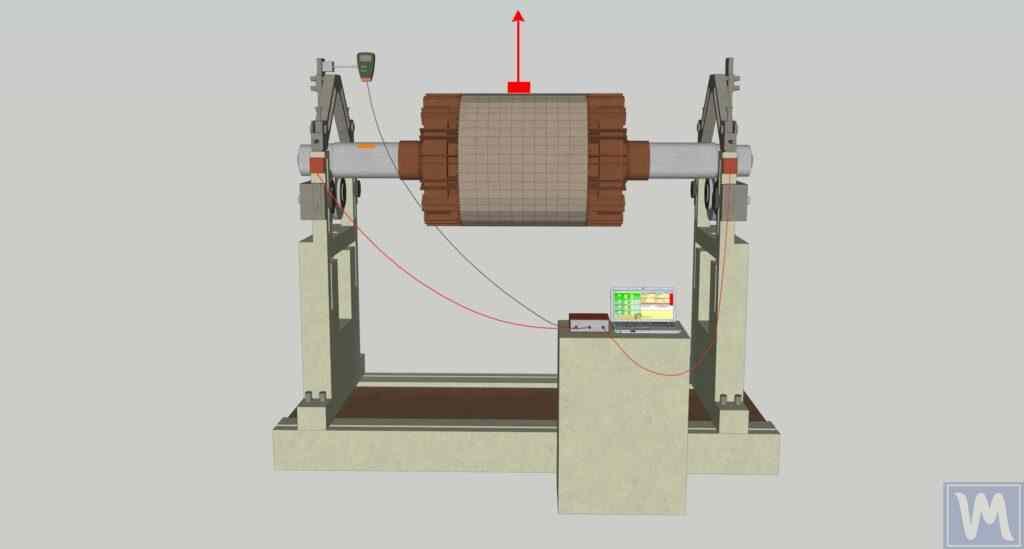
Photo 1. A centrifuge rotor mounted on a precision balancing machine to remove unbalance.
Safety when working with centrifuges
CRITICAL SAFETY MEASURES
1. Check before every start-up
- The cover is closed and secured
- There are no foreign objects in the drum
- There are no cracks in the housing or drum
2. The run-up regime
- A smooth build-up of speed (not abrupt!)
- Monitor vibration at every stage
- If any abnormal vibration appears — stop immediately
3. No overloading
- Do not exceed the rated fill capacity
- Distribute the material evenly within the drum
- Load it symmetrically
The consequences of a drum failure
Documented cases of unbalanced centrifuges failing include:
- Complete destruction of the drum, scattering fragments
- Damage to equipment within a 10–15 metre radius
- Injuries to personnel (in some cases fatal)
- Production shut down for weeks or months
The takeaway: centrifuge balancing is not a question of efficiency — it is a question of SAFETY.
Conclusion
Centrifuges and separators are machines that demand the very highest balancing accuracy. ISO 1940-1 places centrifuges and separators in grade G6.3; high-speed laboratory and separator drums are held to G1–G0.4 in practice, and that is achievable in the drum’s own bearings when the mechanics are sound.
Key rules:
- Run high-speed test runs inside a protective enclosure
- Check the geometry before balancing
- Follow the safety measures strictly
- Monitor vibration regularly
Cutting corners on centrifuge balancing is never acceptable — the cost of getting it wrong is far too high.
Centrifuge balancing
Precision balancing (grades G0.4–G2.5)
Quick checklist
- Run high-speed test runs inside a protective enclosure
- Check geometry and housing for cracks first
- Verify cover closed and no foreign objects before start
- Build speed smoothly and monitor vibration
- Stop immediately if abnormal vibration appears
- Load material evenly and within rated capacity