Last reviewed 30 July 2026
Balancing Mulcher Rotors: A Guide for Forestry and Agriculture
In shortMulcher rotors turn at 1,000–3,000 rpm, flail mowers up to 4,000, and on a 500 kg rotor a 30 g difference at a 300 mm radius is already serious unbalance. Balance forestry mulchers every 200 engine hours or at each cutter change, agricultural ones once a season, flail mowers every 100–150 hours.
When this applies
- After replacing all cutters or knives
- Routine maintenance by engine-hours schedule
- Frame vibration, knocking or overheating bearings
- After a cutter breaks on hitting stone or metal
When it doesn’t
- Stop work immediately with a broken cutter
- Only balance a fully cleaned rotor
- Replace cutters in matched pairs or as a full set
A mulcher is a machine for shredding vegetation: from branches and scrub to whole trees. A massive rotor fitted with knives or hammers spins at high speed (1000–3000 rpm), generating colossal centrifugal forces. Unbalance here is critical!
Types of mulcher and their rotor assemblies
1. Forestry mulchers
Use: clearing forestry land, shredding stumps, preparing firebreaks.
Rotor design:
- A massive drum 400–700 mm in diameter
- 1000–2500 mm long
- Carbide cutters/hammers (30–100 pieces)
- Rotational speed 1000–2000 rpm
- Rotor mass 300–1500 kg
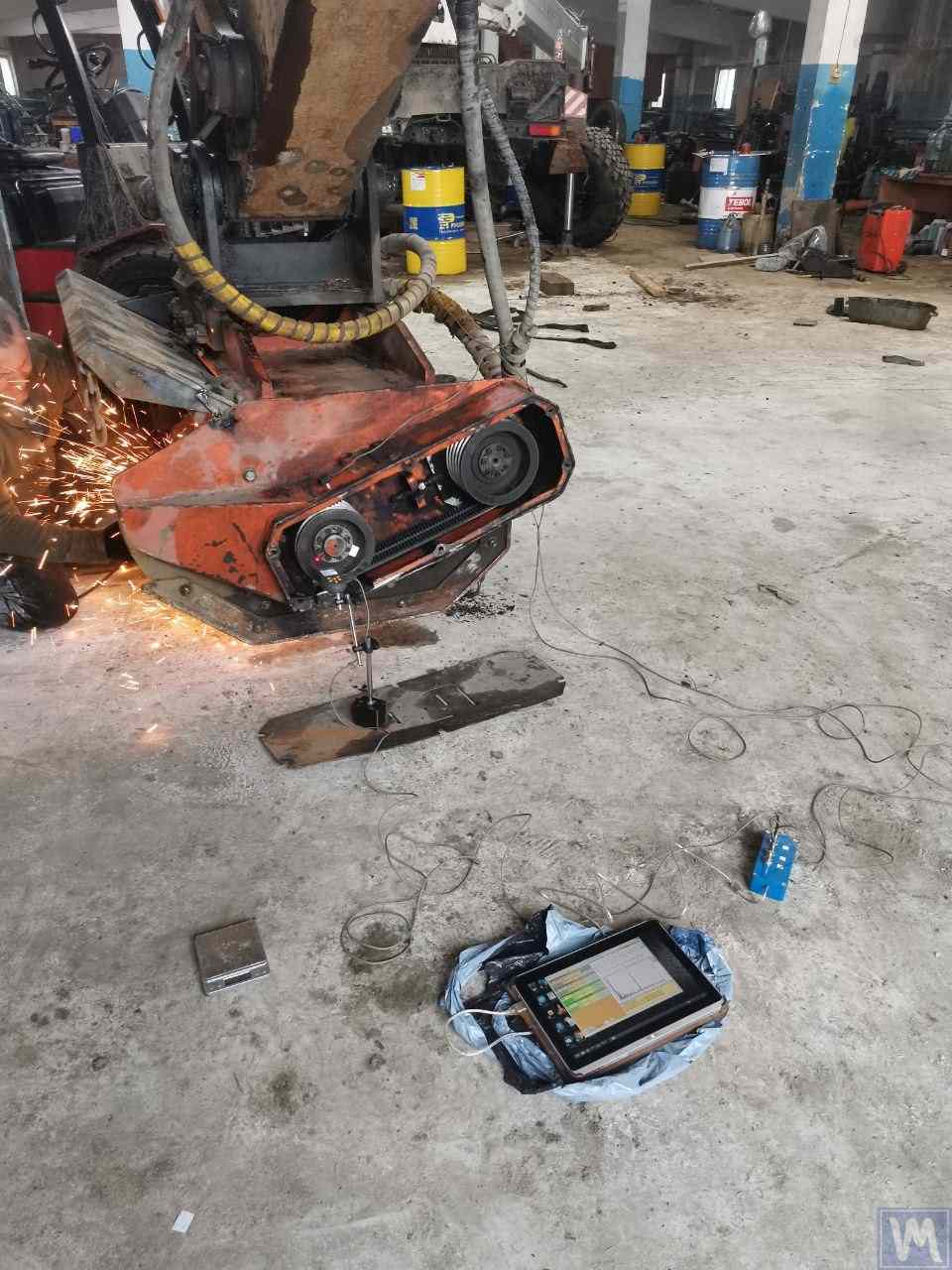
Photo. A forestry mulcher rotor on a balancing rig. The carbide cutters are visible, with vibration sensors connected to the measuring equipment
2. Agricultural mulchers
Use: shredding crop residues, mulching soil, weed control.
Design: lighter, speeds up to 3000 rpm, hinged hammers or Y-shaped knives.
3. Flail mowers and branch chippers
Use: gardening, municipal landscaping.
The specifics: compact but high-speed (up to 4000 rpm) — even a small unbalance creates strong vibration.
Why unbalance develops in mulchers
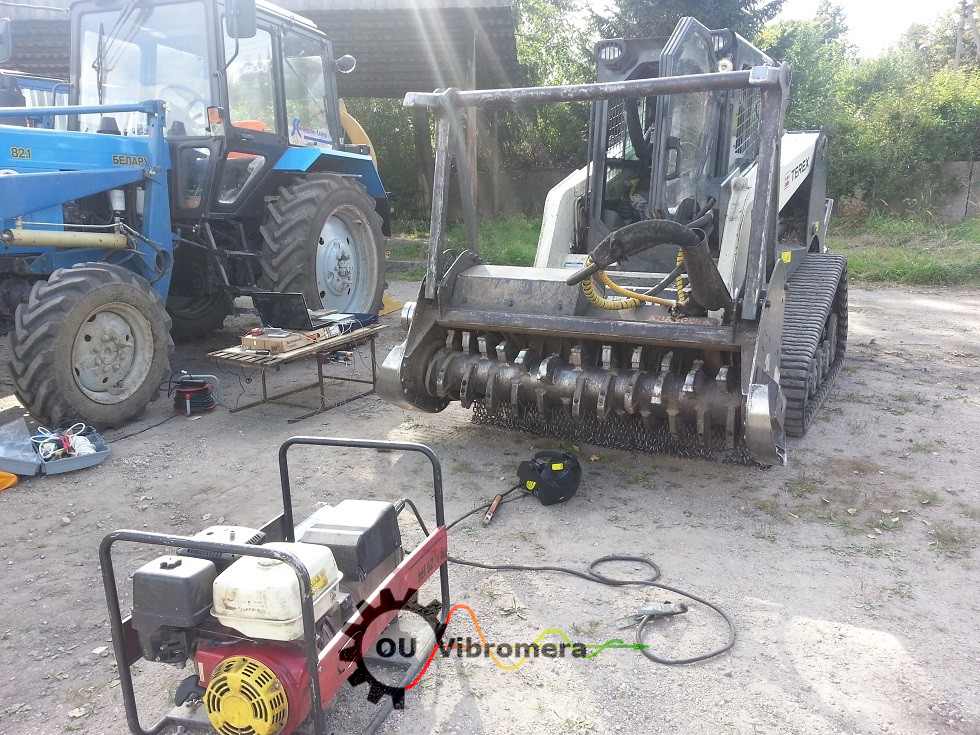
Photo 2. Balancing a mulcher rotor: the Balanset connected to the sensors, with unbalance diagnostics being carried out before correction
Cause 1: Uneven cutter/knife wear
The mechanism: when working over soil or stones, the cutters wear unevenly. One may lose 50 grams of carbide, another 20 grams.
The result: on a 500 kg rotor, a difference of 30 grams at a radius of 300 mm = a serious unbalance.
Cause 2: Broken cutters
The situation: on striking a stone, metal or stump, a cutter flies off or breaks.
The consequences: an instant loss of mass (a cutter weighs 200–500 grams). Vibration rises abruptly.
Symptoms that balancing is needed
| Symptom | What it means | Urgency |
|---|---|---|
| Vibration of the linkage frame | Rotor unbalance transmitted to the tractor | Medium |
| Noise and knocking during work | A broken cutter or heavy wear | High |
| Overheating bearings | Increased load from vibration | High |
| Rapid bearing wear | Chronic unbalance | Medium |
| Cracks in the weld seams | Fatigue failure from vibration | Critical |
The process of balancing mulcher rotors
Method 1: Balancing on a machine (for overhauls)
When: overhaul, replacing all cutters, rotor deformation.
The process:
- Remove the rotor from the mulcher
- Bring it to a workshop with a balancing machine
- Clean the rotor down to the metal
- Check the geometry (radial and axial runout)
- Balance in two planes
- Fit correction weights (welding or drilling)
Advantages: high accuracy (grade G6.3–G16), full control, the option of fault inspection.
Method 2: Balancing in its own bearings
When: routine maintenance, a small unbalance, no option to dismantle.
The process (with the Balanset-1A):
- Clean the rotor (without dismantling)
- Fit vibration sensors to the bearing housings
- Fit a laser tachometer and a reference mark on the rotor
- Take the measurements (Run 0, 1, 2)
- Calculate and fit the correction weights
Advantages: no dismantling, fast (2–3 hours), cheaper.
Practical recommendations
Maintenance schedule
| Mulcher type | Operating regime | Balancing |
|---|---|---|
| Forestry (stumps, trees) | Extreme | Every 200 engine hours or when cutters are replaced |
| Agricultural (grass, haulm) | Medium | Once a season (spring) |
| Flail mower (branches) | Intensive | Every 100–150 engine hours |
Real-world case: a forestry mulcher in logging
The object
Equipment: a mounted FAE UML/SSL forestry mulcher
Rotor: 700 mm diameter, 1800 mm long, 65 carbide cutters
Carrier: an excavator mulcher
The problem
- Strong vibration during work (14 mm/s)
- Overheating rotor bearings (90°C)
- Cracks in the casing weld seams
- Accelerated cutter wear (uneven)
The solution
- Replace ALL 65 cutters with a new set
- Clean the rotor
- Check the rotor geometry (runout within limits)
- Balance on a machine in the workshop (rotor removed)
- Repair the cracks in the casing (re-welding)
- Replace the bearings
The result
- Vibration: from 14 to 3.2 mm/s
- Bearing temperature: from 90° to 55°C
- Output: +12% (less downtime)
- Cutter life: increased by 30%
The economics
Costs:
- Set of FAE cutters (65 pieces): €20,800
- Bearings (2 pieces): €3,400
- Balancing + repair: €3,800
- TOTAL: €28,000
Benefit (a 6-month season):
- Downtime avoided: 10 days × €6,000 = €60,000
- Increased cutter life: 30% = €6,200
- 12% output increase: +€19,200
- Total benefit: €85,400
ROI: €85,400 / €28,000 = 3.05×
Payback: in 2 months of work!
Conclusion
Mulchers are heavy machines working in extreme conditions. Balancing their rotors is not just an "improvement" here — it is a critical factor for reliability and safety.
Key principles:
- Prevention: balancing on schedule + after every cutter change
- Completeness: change cutters in matched pairs (weight difference up to 100 g) or as a full set; if a full set isn't available, arrange the rest symmetrically around the rotor
- Cleanliness: only balance a clean rotor
- Reliability: the weight fixings must withstand shock loads
Follow these principles and balancing pays for itself in 2–3 months, ensuring trouble-free mulcher operation for the whole season.
Mulcher balancing
Instruments for balancing and specialist services
Quick checklist
- Clean the rotor down to the metal
- Check radial and axial runout geometry
- Replace cutters in matched pairs or as a full set
- Fit vibration sensors and laser tachometer
- Take Run 0, 1 and 2 measurements
- Calculate and fit correction weights