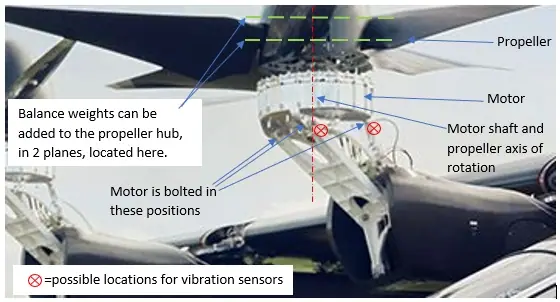
eVTOL propeller balancing: weight and sensor positions
Using eVTOL as an example, it is easy to see that from a balancing point of view this is a conventional rotor, just with an electric drive.
eVTOL means electric Vertical Take-Off and Landing. Each propeller is mounted directly on the electric motor shaft and works as an individual rotor.
The diagram shows:
The propeller and electric motor as a single assembly.
The motor shaft and propeller rotation axis.
Locations on the propeller hub where balance weights can be added. Balancing can be performed in one or two planes.
Typical positions for mounting vibration sensors on the motor housing.
Balanset-1A allows dynamic balancing of eVTOL propellers directly on the installed motor, under real operating conditions, without removing the propeller or motor.
It is important to remember that balancing corrects only mass imbalance. If the propeller has a variable pitch system, there must be no backlash in the pitch mechanism, and all blades must be set to exactly the same angle. Any play or blade angle difference will cause unstable vibration, even after correct balancing.
Balancing always starts with a mechanical check. Only after that does vibration measurement and correction make sense.