How to Balance a Fan: Step-by-Step Guide
Introduction
Industrial fans – from small axial models to massive centrifugal exhaust fans – can start vibrating and making noise over time, signaling rotor unbalance. Rotor unbalance is one of the most common causes of vibration problems and machine failures (second only to bearing wear). A rotating fan with uneven mass distribution creates cyclic loads: when the rotational speed doubles, the vibration force increases fourfold. Such loads lead to accelerated bearing wear, cracks in mountings, and even emergency equipment failure. Fortunately, the problem can be solved without dismantling the unit by performing balancing directly at the operating site.
This guide covers fan balancing methods (static and dynamic), necessary equipment, step-by-step field balancing instructions, and practical tips to avoid common mistakes. The goal is to help maintenance engineers and specialists extend fan service life, reduce vibrations, and prevent equipment downtime through proper balancing.
Fan Balancing Methods: Static vs Dynamic, One Plane or Two
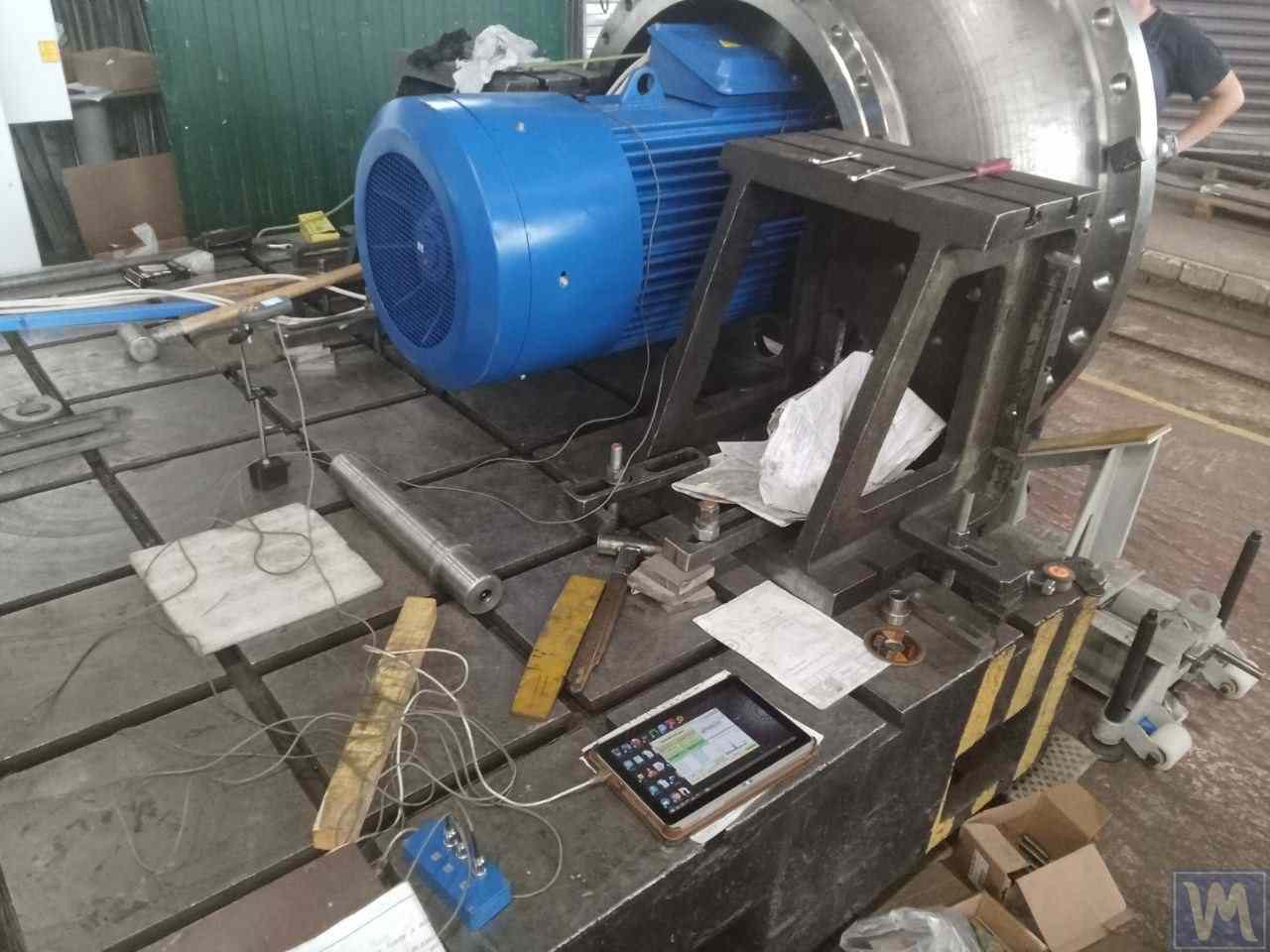
Balancing a rotating fan can be performed using static or dynamic methods. Static balancing involves eliminating unbalance in one plane and is suitable for relatively narrow rotors (impellers) with a small length-to-diameter ratio. For example, small axial fans with blades or lightweight centrifugal fan impellers often use simple static methods.
Classic methods include balancing on knife prisms (the rotor is removed and placed on two parallel sharp edges; the heavy side rotates downward, and weight is attached opposite) and the free rotation method of the impeller ("pendulum") – when the fan is rotated by hand and observed which blade tends to drop down, compensating it with small weights.
Static balancing eliminates force unbalance (center of mass displacement) and is often sufficient for relatively slow and small fans. However, the static method does not correct moment unbalance (distributed unbalance in two planes). If the fan is large, high-speed, or vibration persists after static balancing, dynamic balancing is required.
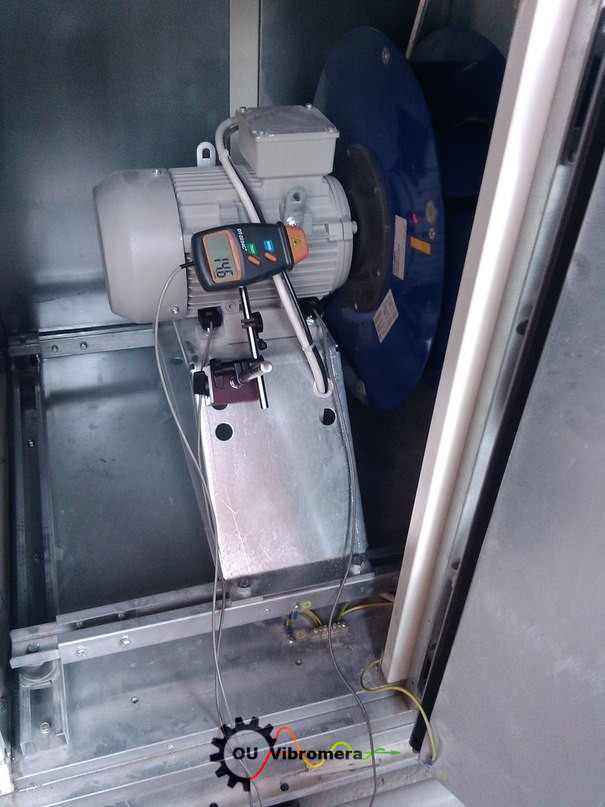
Dynamic balancing is performed on a running fan using measuring instruments. It allows compensation of both static and moment components of unbalance. The principle: a speed sensor (optical tachometer) is fixed on the fan shaft, and vibration sensors are placed on bearing housings. During rotation, the instrument records vibration at the rotational frequency (1×) – its amplitude (mm/s) and phase angle. These parameters represent the unbalance vector.
Equipment for Fan Balancing in Field Conditions
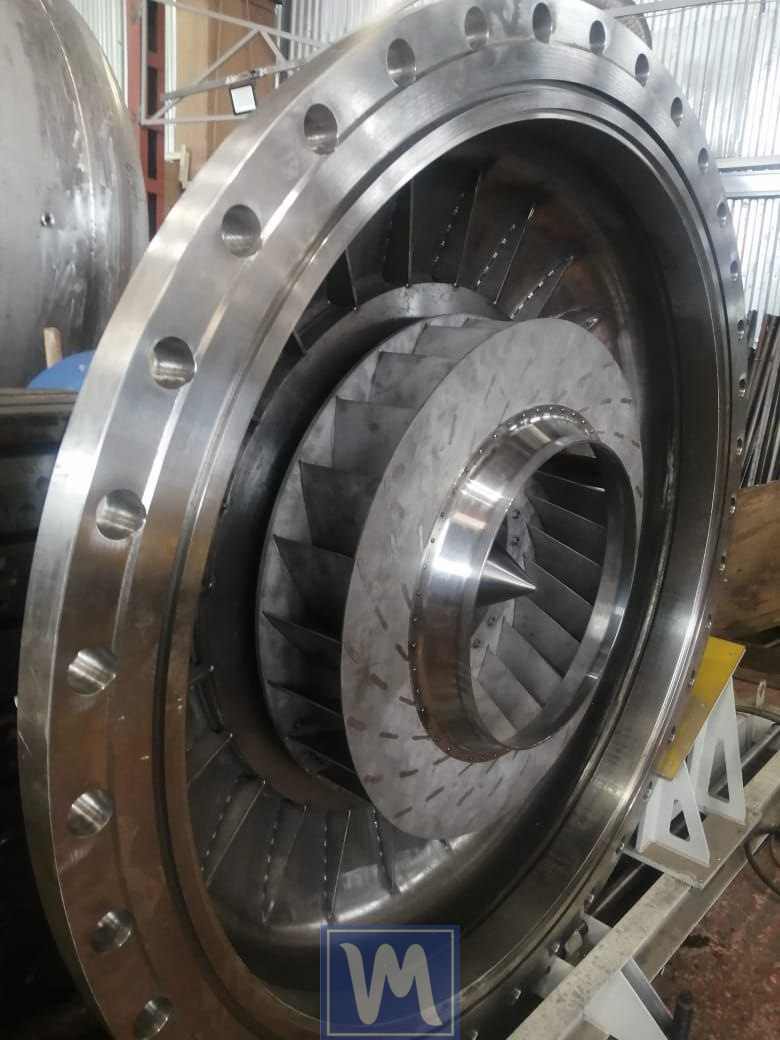
For independent fan balancing, you need a set of measuring equipment and standard tools. The basic set includes:
Vibration Analyzer/Balancing Instrument
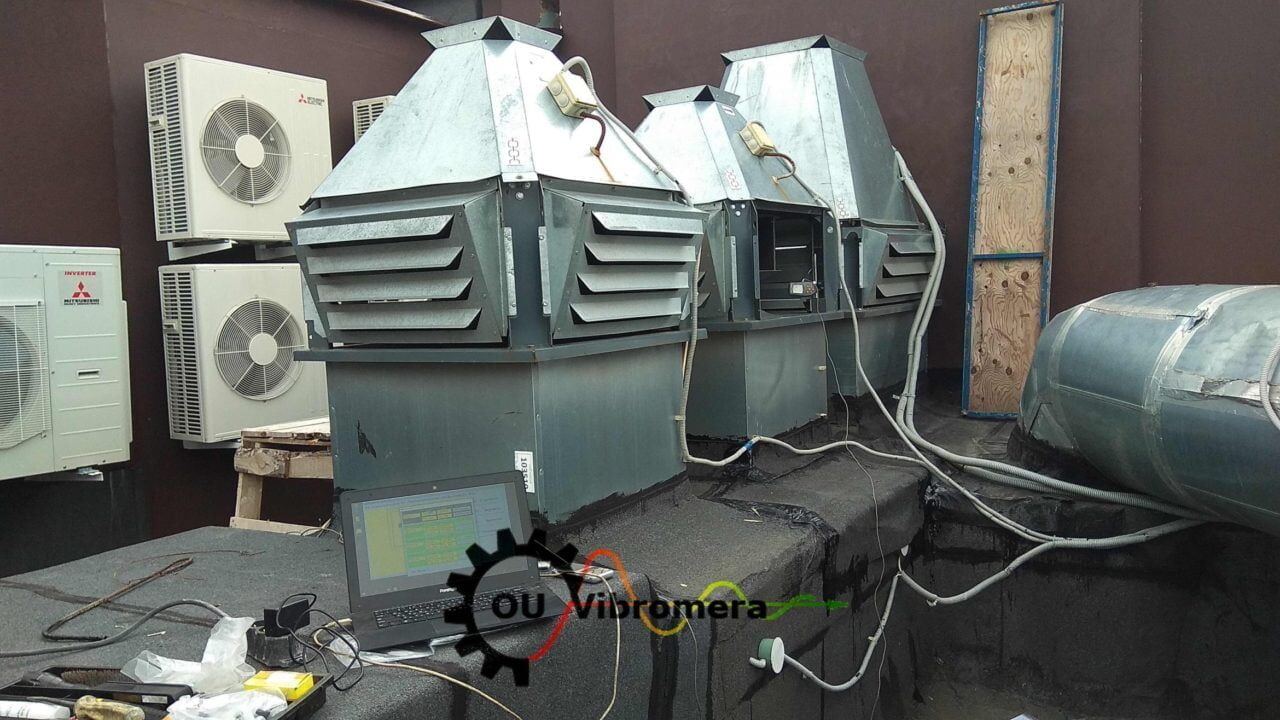
Modern portable instruments, such as the Balanset-1A, are specifically designed to simplify on-site balancing. They are equipped with two channels (for two vibration sensors) and one tachometer channel, allowing two-plane balancing. The instrument connects to a laptop with software that calculates unbalance and suggests corrective actions.
Vibration Sensors (Accelerometers)
Attached to fan supports (usually on bearing housing) in horizontal and/or vertical directions. They measure vibration levels caused by unbalance with high sensitivity.
Optical Speed Sensor (Tachometer)
Directed at the fan shaft where a reflective mark is applied. Records each revolution and phase angle so the instrument can correlate the vibration signal with the rotor's angular position.
Calibration and Correction Weights
Small pieces of metal of known mass (bolts, plates, etc.) that are temporarily attached to the impeller during balancing. They are used for trial runs and calculating the required permanent weight.
Step-by-Step Fan Balancing Procedure (On-Site)
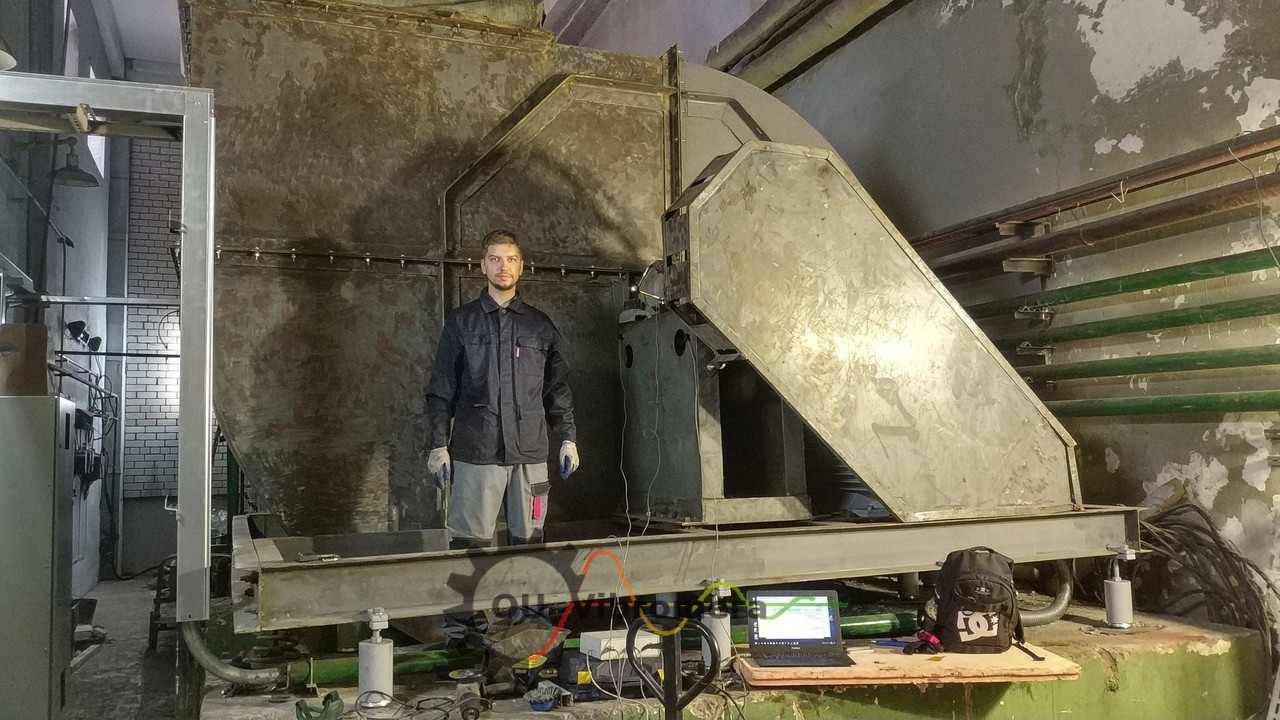
The field method of fan balancing in field conditions includes several stages. Let's consider them sequentially:
1. Preparation and Initial Measurement
Before starting work, be sure to disconnect and de-energize the fan! Perform complete startup lockout (Lockout/Tagout). After stopping, thoroughly clean the fan impeller from dust, accumulated dirt, product deposits, etc. Even a small layer of deposits can create significant unbalance.
In some cases, quality cleaning immediately solves the unbalance problem – vibrations drop to normal, and further balancing is not required. Therefore, this step cannot be neglected.
Next, conduct a visual inspection: ensure there are no cracks on blades, dents, obvious deformations. Check the tightness of all mounting bolts (impeller on shaft, bearing housings, motor and fan supports to frame). Loose connections can mimic unbalance symptoms.
2. Installing Trial Weight
Stop the fan. Temporarily attach a trial weight of known mass (e.g., a bolt weighing ~10-50 grams, depending on rotor size) to the impeller in a convenient accessible area. The weight should cause noticeable vibration change but not exceed 10-20% of rotor mass to avoid damage.
Mark the weight installation angle relative to the initial mark (e.g., 0° is the mark position on the shaft). After attaching the trial weight, start the fan again and measure vibration. Record the new amplitude and phase of oscillations.
3. Calculation and Installation of Correction Weight
The specialized instrument or program now calculates the optimal correction weight. Based on vibration change, the instrument determines what weight and at what angle needs to be installed to compensate for the initial unbalance.
For example, Balanset-1A immediately gives the result: "install 35g at angle 270° in the outer plane." Next, the temporary trial weight is removed and a permanent correction weight of calculated mass is attached in its place (or another specified position).
4. Verification and Finishing
After installing the correction weight, start the fan for a control run. Measure the vibration level – it should significantly decrease. Compare the obtained vibration with normative values or target level. If vibration still exceeds permissible (e.g., above the required balancing class), there may be residual unbalance remaining.
Features of Balancing Different Types of Fans

Centrifugal Fans
Have a massive impeller (blade wheel) with blades attached to the shaft. Centrifugal fan balancing is usually performed in two planes since the wheel is quite wide. The main feature is the tendency to accumulate material on blades during operation (dust, dirt, product buildup).
Axial Fans
Represent a propeller (blades fixed on a hub). Axial fan balancing can be more complex due to aerodynamic forces – at idle (without flow load) vibration may differ from operating conditions.
High-Pressure Industrial Fans
Include turbofans, boiler exhaust fans, large cooling tower fans, etc. They usually operate at high speed and are critical to balancing. Requirements for residual unbalance in such machines are higher – typically balanced to class G2.5.
Practical Tips for Fan Balancing (Checklist)
- Always start with vibration cause diagnosis. Ensure increased vibration is actually caused by rotor unbalance.
- Don't neglect the preparation stage. Perform all mechanical checks before balancing: impeller cleaning, fastener tightening, eliminating play.
- Don't remove old balancing weights unnecessarily. If the impeller already has factory or previous weights, don't remove them all at once.
- Conduct multiple measurements for reliability. Before installing trial weight, make 2-3 fan runs and ensure vibration analyzer readings are stable.
- Ensure work safety. Balancing a rotating fan is a potentially dangerous procedure. Always perform LOTO.
- Record results and keep a log. After balancing, record final vibration levels, weight mass and position.
Conclusion
Fan balancing is a necessary procedure for maintaining reliable and efficient industrial equipment operation. A properly balanced fan not only vibrates less but also lasts longer: bearing load decreases, and the risk of emergency downtime is reduced.
Modern instruments like Balanset-1A significantly simplify the process by automating calculations and allowing fan balancing on-site without disassembly. This makes the method accessible even to regular maintenance department employees.
FAQ on Fan Balancing
Q1: Why does fan unbalance occur?
A: Unbalance means uneven mass distribution of the rotor relative to the axis. Causes can be production-related (inaccurate casting or assembly, machining errors) and operational. In practice, operational factors are most often to blame: over time, dirt, dust, and product residues accumulate on blades, shifting the center of gravity.
Q2: How to tell if a fan needs balancing?
A: The main sign is increased vibration during operation. You may feel shaking on the housing, frame, increasing noise, hum, possibly beating. Often vibration is visually noticeable: for example, a table or foundation under the fan noticeably vibrates.
Q3: Can a fan be balanced without dismantling (on-site)?
A: Yes, moreover – this is the preferred method for large equipment. So-called field balancing is performed using portable instruments directly on the mounted fan.
Q4: What's the difference between static and dynamic balancing?
A: Static balancing is rotor balancing in one plane. It compensates for static unbalance when the heavy point is displaced but the rotor is relatively narrow. Dynamic balancing is a more complex process performed on a running (rotating) fan with vibration measurement.
Q5: Do new fans need balancing after installation?
A: Usually new fans come from the factory already balanced. However, during on-site installation, conditions change: mounting method, connection to motor, structure's own vibrations – all this can lead to the assembled unit vibrating above normal.
Q6: How often should fan balancing be performed?
A: There's no rigid schedule like "balance once a year." Balancing is performed based on condition – that is, when signs of unbalance appear. Within the vibration monitoring program, measure fan vibration at least quarterly.
Q7: What if vibration doesn't disappear after balancing?
A: If you performed balancing according to all rules but the fan still vibrates strongly – the cause is probably not just unbalance. First, analyze the spectrum again: perhaps the main component is not 1×.
Q8: How to properly secure balancing weights on the wheel?
A: Temporary trial weights are usually secured with clamps, ties, or even double-sided tape (if the weight is small and speed is low). But the permanent correction weight must be secured very reliably. Most often welding is used: a metal plate of required mass is welded to the fan impeller (disk).